
Best Canister Vacuums for Multi-Level Homes With Stairs
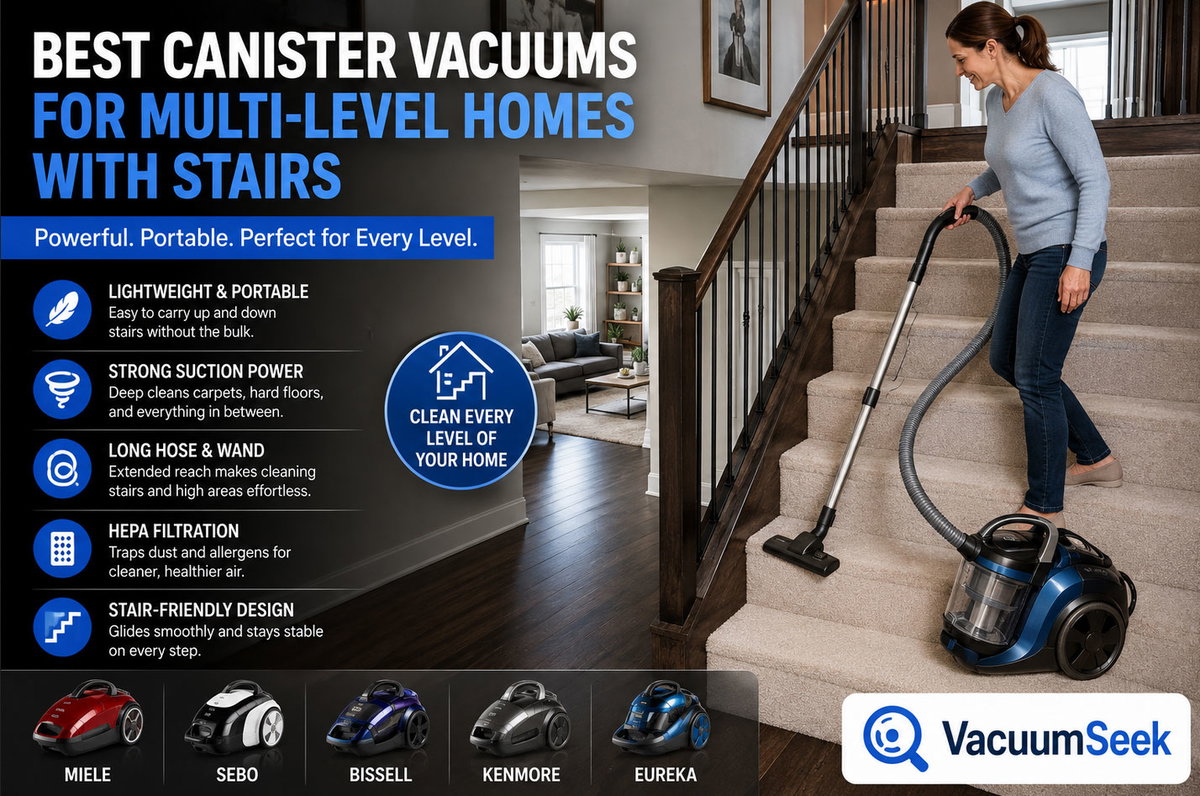
There's a particular kind of exhaustion that comes from owning a three-story house and an upright vacuum. You haul the thing up one flight, do the bedrooms, haul it back down, do the living room, then remember the basement stairs still need attention and the cord won't reach past the landing. Somewhere around the second trip, most people start wondering if there's a better way to do this.
There is. Canister vacuums were solving this exact problem long before "multi-level cleaning" became a marketing phrase. Because the motor and dirt bin live in a low, wheeled unit that trails behind you on a hose, you're never lifting the whole machine up a staircase — just a lightweight wand and a few feet of flexible tubing. For homes with stairs, split levels, or a finished basement that never quite gets the attention it deserves, that difference in ergonomics adds up to a lot less strain over a lot more years.
This guide walks through what separates a genuinely good canister vacuum from one that looks good in a showroom, reviews the models worth your money in 2026, and answers the practical questions people actually type into a search bar at 9 p.m. while standing at the top of their stairs holding a broken vacuum.
Quick Answer: The Short List
If you're short on time, here's the condensed version:
- Best overall for multi-level homes: Miele Complete C3 — the most refined canister on the market, with the balance and hose reach to handle three floors without complaint.
- Quietest and gentlest on furniture: SEBO Airbelt K3 Premium — German-built, whisper-quiet, and padded to survive every accidental bump into a stair railing.
- Best American-made, buy-it-for-life option: Riccar or Simplicity canisters from Tacony Corporation — sold through independent dealers with serious warranty support.
- Best budget bagged pick: Kenmore 81414 Pet Friendly — inexpensive, bagged (good for allergies), and widely available.
- Best ultra-lightweight budget pick: Eureka WhirlWind XL or Eureka 3670M — under 9 pounds and easy to carry one-handed up a flight of stairs.
Now, the reasoning behind each of these — and what to check before you buy.
Why Canister Vacuums Are the Natural Fit for Homes With Stairs
Upright vacuums put all their weight — motor, bag, brush roll, housing — into a single unit you have to lift, tilt, and carry. On a staircase, that means hoisting eight to fifteen pounds of awkward, top-heavy machine up each step, usually one hand on the vacuum and one on the railing, hoping you don't misjudge a stair edge.
A canister vacuum splits that weight in two. The heavy part — motor, bag, filtration — stays on the floor at the base of the stairs on its wheels. What you actually carry is the wand and hose, which typically weigh a couple of pounds. That's the whole appeal: you're managing a garden hose, not a small appliance, while you work your way up and down.
Canisters also tend to ship with more attachments than uprights, and those attachments matter more on stairs than almost anywhere else in the house. A crevice tool gets into the corner where the stair tread meets the riser. A dusting brush handles the baseboards along a staircase without you needing to switch machines. And because the hose has real reach — often 20 to 30 feet once you add the cord — you can frequently vacuum an entire staircase from a single outlet at the bottom or top, without dragging the canister itself up a single step.
Robot vacuums, for what it's worth, don't do stairs at all — they're excellent for single-level upkeep between deeper cleans, but they can't cross a landing, and most multi-level households end up owning both a robot for daily maintenance and a canister for the stairs, edges, and upholstery a robot can't reach.
What Actually Matters When You're Hauling a Vacuum Up and Down Stairs All Day
Not every "canister vacuum" is built with stairs in mind. A few specs separate the ones that make stair day tolerable from the ones that make you dread it.
Weight and Balance
The canister body itself matters less than you'd think, since it usually stays on the floor. What matters is the wand-and-hose weight — the part you're actually lifting and swinging as you climb. Look for canisters in the 10-to-14-pound total range with hoses that don't feel stiff or spring-loaded; a hose that constantly tries to snap back to its resting shape will fight you on every stair.
Hose and Cord Reach
This is the single most important spec for multi-level homes. A combined hose-and-cord reach under 25 feet means you'll be hunting for outlets constantly. The better canister vacuums offer 30-plus feet of working radius, which is often enough to clean an entire staircase and the landing at both ends from one plug.
Bagged vs. Bagless
Bagged canisters seal dust and allergens inside a disposable bag the moment you empty them, which makes them the better choice for households with allergy or asthma sufferers. Bagless models save you the recurring cost of bags but expose you to a small cloud of dust every time you empty the bin — something worth avoiding if you're doing that emptying at the top of a staircase.
Filtration
If anyone in the house has allergies, sealed HEPA filtration is worth paying for. It keeps fine particles — the ones that trigger reactions — from blowing back out of the exhaust while you clean. This matters even more on stairs and landings, which tend to collect dust that gets kicked back into the air with every step.
Noise
Stairwells and hallways carry sound in a way that open living rooms don't. A vacuum that measures 75+ decibels can feel genuinely unpleasant in an enclosed stairwell, especially if you're cleaning while other people are home. Several of the picks below measure in the low-to-mid 60s, which is a noticeably calmer experience.
Attachments That Actually Get Used
Skip the vacuums that pad their box with six tools you'll never touch. For stairs specifically, prioritize a crevice tool, a stair/upholstery combination brush, and a dusting brush — that's the trio that actually earns its keep on a staircase.
The Best Canister Vacuums for Multi-Level Homes With Stairs
1. Miele Complete C3 — Best Overall for Serious Multi-Level Cleaning
Miele's Complete C3 line is the benchmark other canister vacuums get measured against, and on a staircase, the reasons are obvious the first time you use one. The canister glides low to the ground on rubber-coated wheels, the hose swivels without fighting your hand, and the higher-end editions (Calima, Marin, Cat & Dog) run a 1200-watt motor with digital suction control you can adjust without bending down.
Pricing spans a wide range depending on the edition — from around $649 for the entry-level Complete C3 125 Gala up to roughly $1,779 for the top HomeCare+ model, with the Cat & Dog edition (aimed at pet owners, with an anti-tangle floorhead) landing around $1,259. Every Complete C3 uses Miele's sealed bag system with a self-sealing collar, which matters for allergy sufferers, and the line carries a seven-year motor warranty — genuinely long for a vacuum in this category.
The trade-off is cost, and the fact that Miele's bags aren't interchangeable with generic brands. But for a multi-level home that gets vacuumed several times a week, the C3's balance and low weight-to-lift ratio make it the pick most reviewers keep coming back to.
2. SEBO Airbelt K3 Premium — Quietest, Most Furniture-Friendly
If your stairs have a railing, a wall, or furniture on either side — which is to say, if you have stairs at all — the SEBO Airbelt K3 Premium's signature feature is worth knowing about: a soft rubber "airbelt" that wraps around the canister and absorbs impact when it bumps into a wall or banister, protecting both the vacuum and your paint job.
The K3 Premium runs a 1250-watt motor, measures roughly 63 decibels in operation (genuinely quiet for a corded vacuum), and offers around 37 feet of combined hose-and-cord reach — enough to cover most staircases from a single outlet. Its S-Class filtration captures more than 99.97% of particles down to 0.3 microns, putting it in the same allergy-friendly tier as Miele. It ships with the ET-1 electric power head for carpet and a parquet brush for hard floors, and it weighs about 12.7 pounds all in.
Street pricing generally lands between $700 and $950 depending on the color and bundle, and SEBO backs the motor with a seven-year warranty from the factory — often extended further through authorized dealers. It's a strong pick for households that value quiet operation and don't want to think about their vacuum bumping into anything on the way up the stairs.
3. Riccar Tandem Air / Simplicity Canisters — Best American-Made, Buy-It-for-Life Option
Riccar and Simplicity, both made by Tacony Corporation, occupy a smaller but loyal corner of the vacuum market. These canisters are designed and assembled at Tacony's manufacturing facility in St. James, Missouri, and sold almost exclusively through independent vacuum dealers rather than big-box retailers — which means you'll typically get a real conversation and a demonstration rather than a shrink-wrapped box off a shelf.
The standout engineering feature is Tandem Air Technology, which uses two separate airflow paths — one for the floor nozzle, one for onboard tools — so suction doesn't drop off when you switch from the power head to a crevice tool mid-staircase. Riccar models generally include sealed HEPA filtration, and because they're sold through dealers, warranty support tends to be more hands-on than what you get from an online-only purchase.
Pricing varies more than with Miele or SEBO, since it depends on the local dealer and specific model, but the value proposition is longevity: these are vacuums built to be repaired and serviced for a decade or more rather than replaced every few years.
4. Kenmore 81414 Pet Friendly — Best Budget Bagged Canister
Kenmore's canister line — now made under license by Cleva, with the Kenmore trademark owned by Transform SR Brands LLC — still delivers a lot of vacuum for the money. The Kenmore 81414 Pet Friendly canister typically retails around $199, making it one of the more affordable bagged options on this list, which matters if allergy control is a priority but a $900 vacuum isn't in the budget.
It's not going to out-engineer a Miele or a SEBO, but for households that want a straightforward, sealed-bag canister that handles pet hair reasonably well without a big price tag, it's a sensible entry point — and bagged models like this one keep collected dust and allergens contained in a way bagless budget vacuums generally can't match.
5. Eureka WhirlWind XL / 3670M — Best Ultra-Lightweight Budget Pick
Consumer Reports has pointed to the Eureka WhirlWind XL as a smart pick for homes without much carpet, and Eureka's 3670M canister tells a similar story: light, simple, and inexpensive. The 3670M weighs about 8.6 pounds, runs a 12-amp motor, and includes a 2.5-liter bag, a 15-foot cord, and a basic attachment set (crevice tool, dusting brush, extension wands).
These aren't the vacuums to buy if you have thick carpet, multiple pets, and allergy concerns — noise levels run higher than the German-engineered options above, and suction is noticeably more modest. But for hard floors, low-pile carpet, and stairs in a home where the budget matters more than the badge on the canister, an Eureka gets the basic job done without asking you to carry much weight while doing it.
If You'd Rather Skip the Canister Entirely
Canisters aren't the only way to solve the stairs problem — they're just usually the most cost-effective and durable one. Two alternatives worth knowing about:
Shark Rotator Lift-Away models are uprights with a genuinely useful trick: the canister pod detaches from the main body, turning into a lightweight portable unit you carry up the stairs on its own, tools attached. If you already prefer an upright for your main floors and don't want to own two separate machines, this hybrid approach is worth a look.
Dyson V15 Detect, a cordless stick vacuum, converts to a handheld in seconds and carries genuinely strong suction for its size, with a motorized head that adapts across carpet and hard floors. It skips the cord entirely, which some multi-level households find liberating — no hunting for outlets between floors — though battery runtime becomes the new constraint instead.
Neither replaces a canister's raw capacity for a large, heavily carpeted multi-level home, but both are legitimate options if portability matters more to you than outright cleaning power.
Quick-Glance Comparison
| Vacuum | Type | Approx. Weight | Noise Level | Best For |
|---|---|---|---|---|
| Miele Complete C3 | Bagged canister | ~13 lbs | ~66 dB | Overall performance, allergies |
| SEBO Airbelt K3 Premium | Bagged canister | ~12.7 lbs | ~63 dB | Quiet operation, furniture protection |
| Riccar Tandem Air | Bagged canister | Varies by model | Moderate | Longevity, dealer support |
| Kenmore 81414 Pet Friendly | Bagged canister | Lightweight | Moderate | Budget, pet hair |
| Eureka 3670M | Bagged canister | ~8.6 lbs | ~90 dB | Ultra-budget, hard floors |
| Shark Rotator Lift-Away | Upright w/ detachable pod | Pod is light | Moderate | One machine, multi-purpose |
| Dyson V15 Detect | Cordless stick | ~6.8 lbs | Low-moderate | No cords, portability |
How to Actually Vacuum Stairs Without Losing Your Patience
A canister vacuum solves half the battle; technique solves the rest.
- Plug in at the base or the top, not the middle. Most canisters have enough hose-and-cord reach to cover a full flight from one end. Test this once and you'll know exactly where to stand every time after.
- Work top to bottom. Debris you dislodge on upper stairs will fall to lower ones, so cleaning downward means you're not redoing steps you already finished.
- Use the crevice tool on the tread-riser seam first. That's where dust and pet hair accumulate most, and a wide floor nozzle usually can't reach into that tight angle.
- Switch to the upholstery brush for carpeted stairs, not the standard floor head. Carpeted stair treads respond better to a smaller, angled tool than the wide power nozzle designed for open floors.
- Do the railings and baseboards last, with the dusting brush, so any dust that settles during steps 1–4 gets picked up rather than resettling on stairs you already cleaned.
Matching the Vacuum to Your Household
If someone in the house has allergies or asthma: prioritize sealed HEPA filtration and a bagged design — the Miele Complete C3 and SEBO Airbelt K3 Premium both lead here.
If you have pets and multiple flights of stairs: look for a motorized power head with anti-tangle bristles, which the Miele Cat & Dog edition and Riccar's Tandem Air models both offer.
If you're renting or working with a tighter budget: the Kenmore 81414 or Eureka 3670M will handle stairs and hard floors competently without the premium price tag — just expect a louder motor and fewer refinements.
If your home has four or more levels, including a finished basement: the extra hose-and-cord reach on the SEBO K3 Premium (roughly 37 feet) or Miele C3 line will save you the most outlet-hunting over time.
Manufacturer Contact Information & Where to Buy
For anyone who wants to see a model in person, call with a service question, or verify a warranty before buying, here's where the major brands in this guide are officially based:
| Brand | Company | Address | Website |
|---|---|---|---|
| Miele | Miele, Inc. (Miele USA) | 9 Independence Way, Princeton, NJ 08540 | mieleusa.com |
| SEBO | SEBO America, LLC | 14101 E. Otero Ave. #400, Englewood, CO 80112 | sebo.us |
| Riccar / Simplicity | Tacony Corporation | 1760 Gilsinn Ln., Fenton, MO 63026 (manufacturing in St. James, MO) | tacony.com |
| Kenmore | Transform SR Brands LLC | Hoffman Estates, IL | kenmore.com |
Miele and SEBO both sell through authorized dealer networks in addition to their own sites, so it's worth searching for a local showroom if you'd like a hands-on demonstration before committing — canister balance and hose feel are genuinely hard to judge from a product photo.
For independent research and lab-tested comparisons beyond this guide, Consumer Reports and RTINGS both publish regularly updated, hands-on vacuum testing that's worth cross-checking before a big purchase.
Frequently Asked Questions
Are canister vacuums actually better than uprights for stairs? For most people, yes. Because the heavy motor and bin stay on the ground while only a lightweight hose and wand travel with you, canister vacuums put far less strain on your arms and back when cleaning a staircase compared to lifting a full upright vacuum up each step.
What's the ideal hose-and-cord length for a multi-level home? Aim for at least 25 feet of combined reach, and ideally 30 feet or more if your staircases are long or your outlets are sparse. This lets you clean an entire flight of stairs from a single plug without repositioning.
Should I choose a bagged or bagless canister vacuum? Bagged models are generally the better choice for allergy-prone households, since dust and allergens are sealed inside the bag the moment you empty it. Bagless models save on ongoing bag costs but release a small amount of dust into the air each time you empty the bin.
How much should I expect to spend on a good canister vacuum? Budget-friendly bagged canisters, like the Kenmore 81414 or Eureka 3670M, typically run under $250. Mid-range to premium options from Miele, SEBO, or Riccar generally fall between $650 and $1,800, depending on the specific edition and included attachments.
Do canister vacuums work well on hardwood stairs, not just carpet? Yes, and often better than uprights. Most canister vacuums ship with a dedicated parquet or hard-floor brush that's gentler than a standard carpet power head, which makes them a strong choice for homes with a mix of hardwood stairs and carpeted upper floors.
Is a robot vacuum a substitute for a canister vacuum in a multi-level home? No — robot vacuums can't cross stairs or landings, so most multi-level households use a robot for daily upkeep on a single floor and a canister vacuum for stairs, upholstery, and the deeper cleaning a robot can't do.
The Bottom Line
The right canister vacuum for a multi-level home isn't necessarily the most expensive one — it's the one whose weight, hose reach, and noise level match how your specific staircases and floors actually get used. A household chasing allergen control and long-term reliability will get the most out of a Miele or SEBO. A household that just wants stairs to stop being a chore, without spending four figures on a vacuum, will do perfectly well with a Kenmore or Eureka. Either way, the core advantage holds across every price point: you're pulling a hose up the stairs, not carrying an appliance.