
Best Swivel Vacuums for Navigating Furniture and Tight Corners
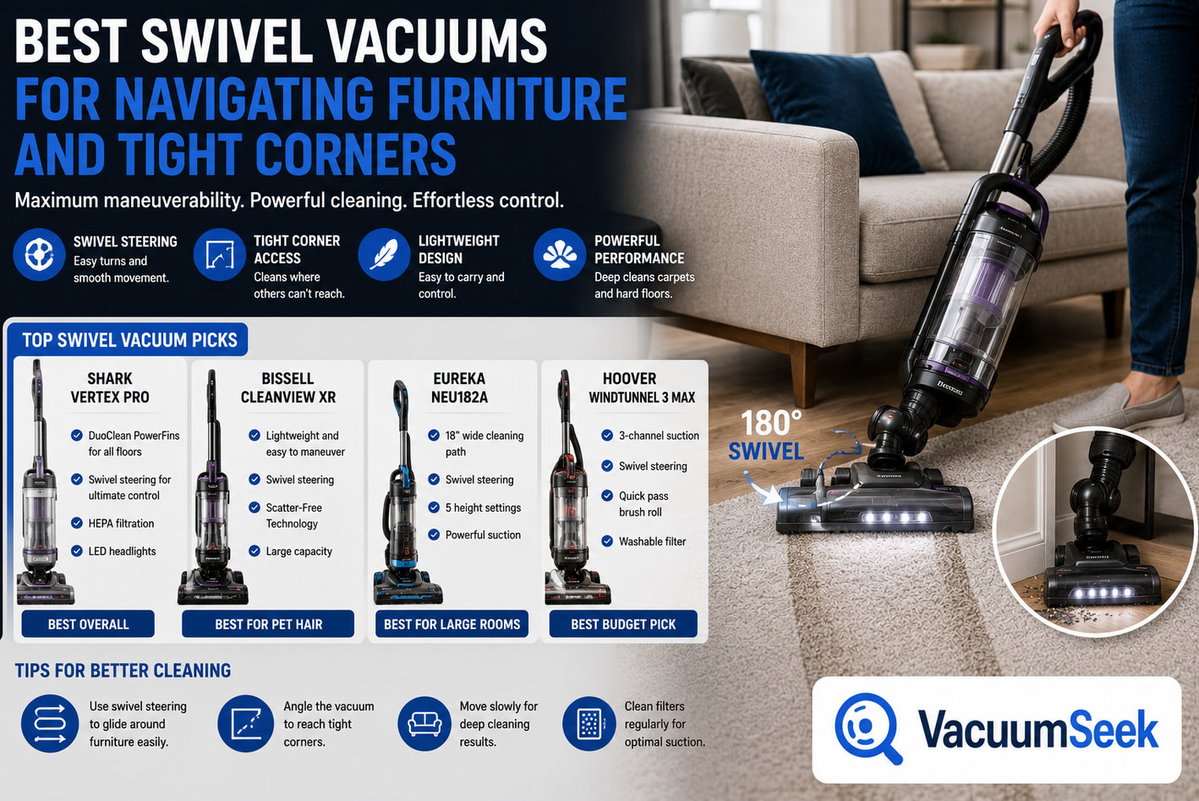
Every home has that one dead zone. The gap behind the reading chair. The three inches under the china cabinet where the dust bunnies have formed a small civilization. The tight pivot around a dining table leg that turns a five-minute clean into a wrestling match with a hose. A vacuum's suction gets all the marketing attention, but the feature that actually determines whether cleaning day feels like a chore or a shrug is how the machine turns. That's swivel steering — and it's the quiet difference between a vacuum you drag and one that seems to read the room.
This guide breaks down what swivel steering actually does, what separates a genuinely maneuverable vacuum from one that just claims to be, and which models earn their spot in furniture-heavy, corner-filled homes. We've pulled in specs and testing notes from current buying guides so you're working with real numbers, not marketing copy.
Why Swivel Steering Is the Feature Nobody Talks About Until They Own One
Most vacuum shopping starts with suction wattage or dustbin capacity, and those numbers matter. But suction is useless if the machine can't physically reach the mess. A rigid-necked upright forces you to back up, reposition, and re-approach every time you hit a chair leg or a cabinet corner. A vacuum with a swivel-steering neck rotates around a pivot point near the cleaner head, which means the body of the machine can lean and turn while the head stays flush against the floor. The practical result is fewer passes, less arm strain, and a machine that glides around obstacles instead of bouncing off them.
This matters more than people expect in homes with a lot of furniture legs, open shelving, or narrow galley-style kitchens. It also matters for anyone managing stairs, pet hair, or a household where the vacuum gets used almost daily rather than as a weekend event. A rigid vacuum in a cluttered room turns into a stop-start chore. A swivel vacuum in the same room turns into something closer to muscle memory.
What Actually Makes a Vacuum "Corner-Ready"
Not every vacuum labeled with "swivel" performs the same way in practice. A few design details separate the machines that genuinely glide from the ones that just pivot a little at the base.
Swivel Radius and Neck Design
The degree of rotation matters. Some machines offer a modest side-to-side wiggle, while others — like the Tineco Go H2O HammerHead, which uses a 128-degree angled swivel steering system built specifically for navigating around furniture and corners — are engineered around a wide arc that lets the head practically spin in place. The wider the effective radius, the less you'll need to reposition your whole body to finish a turn.
Head Profile and Under-Furniture Clearance
A shallow cleaner head profile lets the vacuum tuck under low furniture — sofas, bed frames, kitchen toe-kicks — without you having to move anything. Testing notes on the Shark PowerDetect specifically call out its shallow head as the reason it can slide under and around furniture where bulkier heads simply stop.
Weight and Pivot Point
A heavy vacuum with poor balance fights the swivel mechanism no matter how good the engineering is. Full-size corded uprights typically weigh between 13 and 17 pounds, with the average tested model landing around 15 pounds, and that weight is more noticeable on stairs or when you're doing a lot of tight-corner maneuvering than it is on an open floor. Lighter cordless sticks sidestep this problem almost entirely, which is part of why they've become popular for apartments with more furniture per square foot.
Cord Length or Battery Runtime
Corded models with long cords give you fewer interruptions when working your way around a furnished room; a 30-foot cord, for instance, lets you clear an entire living room and hallway without unplugging. Cordless models trade that for freedom of movement but bring runtime limits into the equation, usually somewhere between 20 and 40 minutes depending on suction mode.
The Best Swivel Vacuums for Furniture-Heavy, Corner-Filled Homes
1. Shark PowerDetect — Best Overall
The PowerDetect keeps showing up at the top of testing roundups for a reason. Despite being on the heavier side, as is common with vacuums that pack a strong motor and a sizable dust cup, it's remarkably agile thanks to swivel steering and a shallow cleaner head that lets it work under and around furniture with ease. Its two-brush cleaner head system adds traction and coverage, cutting down on the number of passes needed, while LED headlights improve visibility in dim corners, and a 30-foot cord keeps you plugged in through an entire room without a mid-clean outlet swap. In testing, it handled everything from Cheerios and rice to kitty litter, sand, and stubborn pet fur across carpet and hard floor tests, and pulled real pet fur out of dense car mats in a single pass. The automatic "Detect" mode reads the surface and adjusts suction on its own, so you're not fumbling with settings mid-clean. This is the pick for someone who wants one vacuum that handles a whole multi-surface, furniture-dense home without a second thought.
2. Shark Navigator Lift-Away Deluxe (NV360) — Best for Getting Under and Around Furniture
If your main frustration is stretching a hose to reach under a sofa or up onto a shelf, the NV360 solves it directly. It pairs strong suction on carpets and hard floors with a detachable Lift-Away pod, so instead of dragging the whole unit under a couch, you lift off the canister and carry just the lightweight portion where you need it. Its swivel steering helps you slip around chair legs and table corners with noticeably less effort than a rigid-neck upright. It's a strong middle-ground choice: full-size cleaning power with the flexibility of a portable pod for the awkward spots a standard upright can't touch.
3. Shark NV151 Navigator Swivel Pro Complete — Best Lightweight Corded Pick
For anyone who finds full-size uprights cumbersome, the NV151 trims the weight without trimming the swivel performance. It offers lightweight handling, strong suction, and swivel steering that slips around furniture with noticeably less resistance than bulkier models. This is the vacuum to consider if your home has a lot of small rooms and doorway transitions rather than one big open floor plan — the lighter chassis makes constant repositioning far less tiring.
4. Bissell CleanView Swivel — Best Budget Canister-Style Pick
The CleanView Swivel takes a slightly different architecture: a bagless canister connected to an extendable hose and wand, controlled with foot pedals rather than handle-mounted switches. It offers five surface settings on the cleaner head base, and in testing it aced both carpet and "kitchen sink" debris tests, pulling up everything in its path right up to the edges of furniture and cabinets. The combination of rear foot pedals and swivel steering made it notably easy to maneuver, and it handled pet fur well, with only a few stray strands needing a second pass. If you want canister-style flexibility with real corner performance at a lower price point than the premium uprights, this is the one to shortlist.
5. Kenmore Bagless Lift-Up DU5092 — Best Budget Upright
Kenmore's DU5092 punches above its price by bundling features you'd normally expect on a midrange machine. It includes Anti-Allergen Complete Seal with HEPA filtration rated to trap 99.9% of dust and allergens down to 0.3 microns, along with LED headlights, swivel steering, and a bagless 1.04-liter dust cup powered by a 1,300-watt motor. It also comes with a self-cleaning pet power brush, a pet crevice tool, and a wide upholstery tool, which makes it a genuinely versatile pick for pet owners on a budget who still want the corner-hugging benefit of swivel steering.
6. Tineco Go H2O HammerHead — Best Cordless Vacuum-and-Mop Combo
For hard-floor households — kitchens, entryways, sealed hardwood living rooms — the Go H2O does double duty by vacuuming and mopping in one pass. It runs up to 25 minutes on a charge and uses a 128-degree angled swivel steering system specifically designed for effortless navigation around furniture and corners, with an updated brush design that makes maneuvering around tight corners and furniture noticeably easier thanks to that angled swivel. It self-cleans after use, which matters if you're mopping and don't want to be scrubbing a brush roll by hand afterward. This is less a traditional vacuum and more a floor-care hybrid, but for anyone whose "tight corners" problem is really a hard-floor kitchen with a lot of chair legs, it's worth serious consideration.
7. Shark Rotator Pet — Best for Pet Hair in Tight Spaces
The Rotator Pet earned its reputation in pet-hair testing for strong suction paired with nimble steering, and it carries the largest dust cup of any Shark upright tested — a real advantage for households with long-haired or multiple pets who don't want to empty the bin every session. Detachable buttons let you pull the motorized canister free for detail work on stairs, upholstery, and corners without hauling the full unit around. Combined with swivel steering, it's built for exactly the scenario where pet hair collects hardest: baseboards, under furniture, and the tight gap behind the couch cushions.
Where to See These Vacuums in Person
Specs on a page only tell you so much — swivel feel is something you notice with your hands on the handle. If you'd rather test the turning radius yourself before buying, these are useful stops, listed with their headquarters addresses for reference alongside their retail sites:
- Shark / SharkNinja — manufacturer of the PowerDetect, Navigator, and Rotator Pet lines. Corporate offices at 89 A St, Needham, MA 02494. Product details and support: sharkninja.com
- Bissell Homecare — manufacturer of the CleanView Swivel. Headquartered at 2345 Walker Ave NW, Grand Rapids, MI 49544. Full lineup and manuals: bissell.com
- Tineco — manufacturer of the Go H2O HammerHead and other cordless swivel-steering models. Shop direct at store.tineco.com
- Best Buy — carries in-store demo units for most Shark, Bissell, and Tineco models. Corporate headquarters at 7601 Penn Ave S, Richfield, MN 55423. Shop online at bestbuy.com
- Target — stocks a rotating selection of Shark and Bissell uprights. Corporate headquarters at 1000 Nicollet Mall, Minneapolis, MN 55403. Shop online at target.com
- The Home Depot — a reliable source for Bissell, Tineco, and Kenmore models, with in-aisle testing on some floor units. Corporate headquarters at 2455 Paces Ferry Road NW, Atlanta, GA 30339. Shop online at homedepot.com
For independent, hands-on comparisons across brands, Vacuum Wars publishes ongoing monthly testing that's worth cross-referencing before you commit to a model.
Care Tips for Keeping Swivel Mechanisms Smooth
A swivel neck is a mechanical joint, and like any joint, it degrades if it's ignored. A few habits keep it turning the way it did on day one.
- Clear hair and thread from the pivot point. Long hair and thread have a tendency to wind around the base of the swivel neck, and over months that buildup can stiffen the turn radius. A quick check every few weeks with a pair of scissors or a hair-removal tool keeps things loose.
- Don't force a stuck turn. If the head catches on carpet fibers or a rug edge, lift slightly before rotating rather than muscling the handle sideways. Repeated forced turns are the most common cause of loosened or cracked swivel joints.
- Keep the wheels clean. Swivel steering only feels effortless if the wheels underneath are rolling freely. Dust, pet hair, and debris wrapped around the axles will make even a well-engineered swivel neck feel sluggish.
- Store it upright, not leaned at an angle. Leaving a vacuum resting at a lean for long periods can put uneven pressure on the neck joint over time, especially on lighter cordless models.
- Check the manufacturer's washable filter schedule. This isn't swivel-specific, but a clogged filter forces the motor to work harder, and vacuums under strain are more prone to jerky, less controlled turning as the motor struggles.
Frequently Asked Questions
Does swivel steering reduce suction power? No. Swivel steering is a mechanical feature of the neck and pivot design; it doesn't route air differently or reduce motor output. A well-engineered swivel vacuum delivers full suction through the turn.
Are cordless swivel vacuums as maneuverable as corded ones? Generally, yes — often more so, since cordless sticks tend to be lighter and don't have a cord to manage while turning. The tradeoff is battery runtime, which usually caps out between 20 and 40 minutes depending on suction mode.
What's the difference between "swivel steering" and a "pivoting head"? A pivoting head typically rotates only at the very base near the floor, offering a smaller turning arc. True swivel steering rotates higher up the neck, giving the whole body of the vacuum more freedom to lean and turn, which is what actually makes tight corners easier.
Do swivel vacuums work well on stairs? Lighter models with detachable canisters — like Lift-Away style uprights — tend to perform best on stairs, since you can separate the motorized unit from the base rather than hauling the full vacuum up each step.
Is swivel steering worth paying extra for? If your home has more than a couple of pieces of furniture per room, tight hallways, or an open kitchen with a lot of chair and table legs, it's one of the few upgrades that changes the actual experience of cleaning rather than just the spec sheet.
Final Verdict
Suction numbers and filtration ratings matter, but they only tell half the story of how a vacuum performs in a real, furnished home. Swivel steering is the feature that determines whether cleaning day involves fighting the machine or moving through the house without a second thought. For most households, the Shark PowerDetect earns its spot as the best all-around option, balancing strong performance with a genuinely agile turn radius. Budget-conscious buyers land well with the Kenmore DU5092 or Bissell CleanView Swivel, while anyone dealing primarily with hard floors and hard-to-reach corners should give the Tineco Go H2O HammerHead a serious look. Whichever you choose, the test that matters most isn't on the spec sheet — it's whether the vacuum can slide around your actual chair legs without you having to think about it.