
Canister vs. Upright Vacuums: Which Is Right for Your Home?
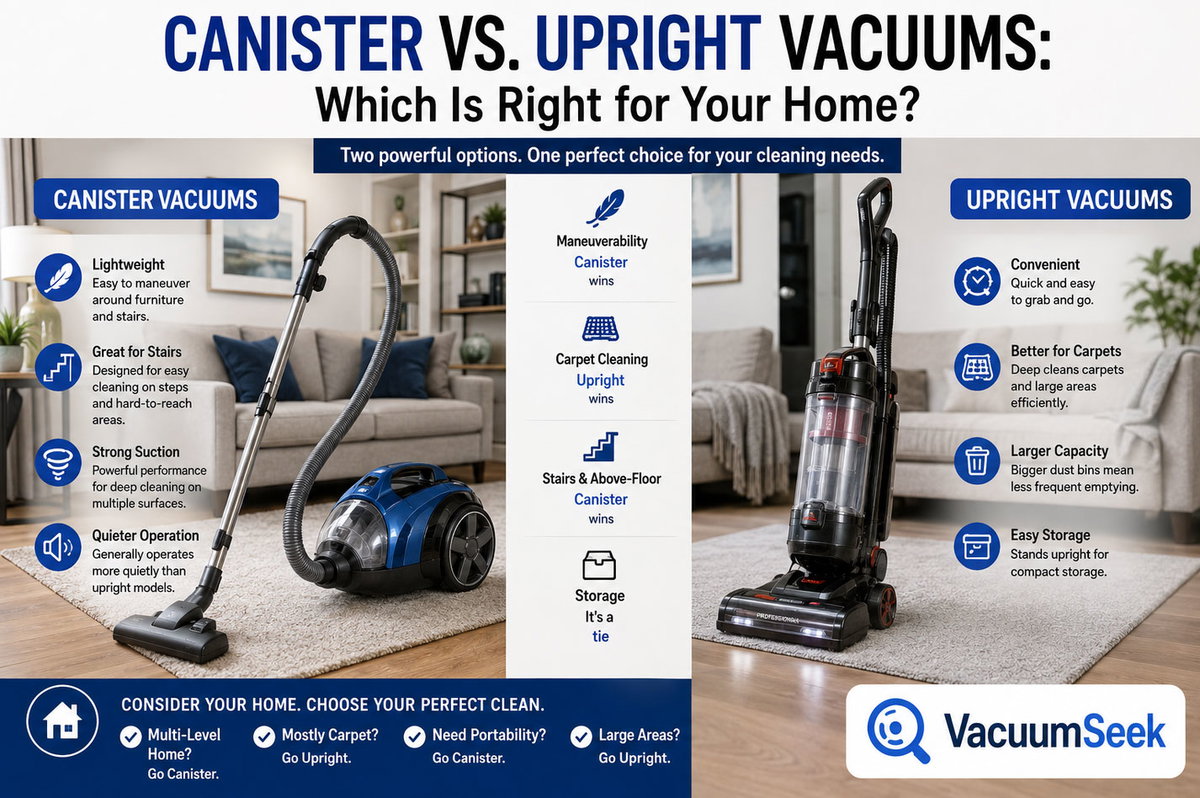
Somewhere between the invention of the vacuum cleaner in 1901 and today's app-connected robot models, two shapes won out over every other design that engineers tried. One stands tall, pushes forward, and dominates American living rooms. The other crouches low, trails a hose behind it, and quietly rules kitchens and stairwells across Europe and much of Asia. Neither one is a relic. Both are still manufactured by the millions every year, and both still have loyal, occasionally fierce, defenders.
If you've stood in the vacuum aisle at a big-box store, or scrolled through a dozen open browser tabs trying to decide, you already know the debate isn't as simple as "which one sucks harder." The right answer depends on your floors, your storage closet, your joints, your allergies, and honestly, your patience for lugging equipment around. This guide walks through the real, practical differences between canister and upright vacuums, so you can make a decision based on how you actually clean your home rather than on marketing copy.
What Actually Separates a Canister from an Upright
The core distinction comes down to where the motor lives.
An upright vacuum houses its motor, dust bin or bag, and cleaning head all in one vertical unit. You push it in front of you, and the brush roll sits directly beneath the motor, which means power transfers straight down into the carpet fibers with very little energy lost along the way.
A canister vacuum splits the machine into two parts. The motor, filter, and dirt container sit inside a wheeled body that stays low to the ground, while a lightweight wand and cleaning head connect to it through a flexible hose. You pull the canister along behind you, guiding only the wand and head with your hands.
That single design choice, motor-on-top versus motor-behind, cascades into nearly every other difference between the two: how loud they are, how heavy they feel, how well they climb stairs, and how much closet space they demand.
How Upright Vacuums Perform in the Real World
Carpet Cleaning
This is the category uprights were built to win. Because the brush roll sits directly under the motor, uprights typically generate strong, consistent agitation on carpet, which helps lift embedded dirt, sand, and pet dander out of the fibers rather than just skimming the surface. Homes with wall-to-wall carpeting, especially thicker or higher-pile styles, tend to see the biggest benefit from an upright's deep-cleaning action.
Coverage and Speed
Upright vacuums usually have a wider cleaning path than canister power heads, so you cover more square footage per pass. For a large, open living room or a finished basement with few obstacles, that wider swath translates into a noticeably faster cleaning session.
Weight and Fatigue
The tradeoff for that all-in-one power is weight. You're pushing the entire machine, motor included, across the floor for the whole session. Many uprights weigh between 15 and 22 pounds, and that weight is concentrated in a unit you're actively maneuvering, not just carrying. Over a large house, that adds up in a way your shoulders and lower back will notice.
Storage
Uprights tend to be closet-friendly. They stand on their own, take up a narrow footprint, and don't require you to coil a hose or nest separate pieces together. If your storage space is a tall, narrow coat closet rather than a deep cabinet, an upright usually fits more gracefully.
How Canister Vacuums Perform in the Real World
Hard Floors and Delicate Surfaces
Canisters tend to shine on hardwood, tile, laminate, and stone. Because the power head is lighter and detached from the motor, it's easier to swap in a soft-bristle floor tool that won't scatter debris or scuff finishes the way an aggressive brush roll can. If your home leans heavily toward hard flooring, especially in kitchens and entryways where grit and mud get tracked in, a canister with the right attachment tends to outperform an upright.
Reach and Versatility
The hose is the canister's superpower. It lets you clean stairs, curtains, upholstery, car interiors, and ceiling corners without hauling the entire machine up with you. For homes with a lot of furniture, tight corners, or awkward layouts, that flexibility often matters more than raw suction.
Noise
Because the motor sits inside an enclosed canister body rather than right beneath your hands, these machines are usually noticeably quieter. If you vacuum while a baby naps, during a video call, or in a shared apartment building with thin walls, that difference is not a minor detail. It's often the deciding factor.
Weight, Sort Of
Here's the twist people don't expect: while the canister body itself can be heavy, you're not pushing that weight around during normal use. You're guiding a light wand and head, and the canister glides on its own wheels behind you. For anyone with wrist, shoulder, or back issues, this can make canisters feel considerably easier to operate, even if the on-paper weight is similar to an upright's.
Storage
This is where canisters lose ground. The two-piece design, body plus wand and hose, takes up more floor space and doesn't stand upright on its own as neatly. If your storage options are limited to a shallow hall closet, a canister can be an awkward fit.
Suction Power: A More Nuanced Story Than You'd Think
There's a persistent myth that canisters are automatically more powerful than uprights, or vice versa. In reality, suction power depends far more on the specific model, motor wattage, and how well the machine is sealed than on the basic body style. What's true across both categories is that a motorized powerhead, an attachment with its own small motor spinning the brush, will out-clean a purely suction-driven head on carpet, whether that head is attached to a canister or built into an upright.
If carpet performance is your top priority, look for a model with a motorized brush roll and check independent testing results rather than trusting the category alone. Consumer Reports publishes detailed vacuum ratings and a buying guide that breaks down performance by surface type, which is a far more reliable way to compare specific machines than relying on "canister" or "upright" as a stand-in for quality.
Noise Levels, By the Numbers
Vacuum noise is measured in decibels, and because the decibel scale is logarithmic, even a small numerical difference feels much larger than it looks on paper. A shift of just three decibels roughly doubles the perceived loudness. Most vacuum cleaners land somewhere around 70 decibels, comparable to a flushing toilet. Canister vacuums often run in the 60 to 65 decibel range thanks to their enclosed motor housing, while even the quieter upright models tend to sit closer to 65 to 70 decibels. If you're sensitive to household noise, or you live with someone who works from home during the day, that gap is worth testing in person before you buy.
Maneuverability, Stairs, and Multi-Level Homes
Stairs are where the two designs genuinely diverge in day-to-day use. With an upright, you're carrying the full unit up each flight, then pushing it across a step that's far narrower than any floor. It's doable, but it's clumsy, and it puts strain on your grip and shoulder.
With a canister, you can leave the body at the bottom of the stairs and simply extend the hose and wand upward, or carry just the lightweight wand from step to step. Homeowners with multiple staircases, split-level layouts, or finished attics often find canisters far less exhausting for this exact reason.
That said, an upright wins in wide-open, single-level spaces. If your home is mostly one flat expanse of carpet with few obstacles, the upright's push-forward simplicity and wider cleaning path let you finish faster with less back-and-forth setup.
Allergies, Asthma, and Air Quality
If allergies or asthma factor into your household, filtration matters more than body style. According to Consumer Reports' guide to vacuums for allergy sufferers, a sealed HEPA filtration system is one of the most reliable ways to keep dust, pollen, and pet dander from being recirculated back into the air while you clean, and bagged models tend to release less dust during emptying than bagless ones. Both canister and upright vacuums are available with sealed HEPA systems, so this isn't really a canister-versus-upright question at all. It's a filtration-and-bag question that cuts across both categories. Sites like Achoo Allergy go further into what "sealed HEPA" actually means versus a filter that's simply labeled HEPA but isn't airtight, which is worth reading before you shop if allergies are a serious concern in your household.
Pet Hair, Specialty Attachments, and Everyday Practicality
Pet owners tend to gravitate toward uprights for the main living areas, since a wide brush roll clears embedded fur from carpet efficiently in long, straight passes. But canisters often win the secondary battle: getting hair off upholstery, stairs, and the inside of a car, tasks where a hose and specialized tool matter more than raw carpet power. Many households with pets end up happiest with either a canister that includes a motorized pet-hair powerhead, or an upright with strong onboard tools for furniture and stairs. The lesson here isn't "buy one type," it's "check what attachments actually ship with the model," since accessory quality varies enormously between brands even within the same category.
Price and Long-Term Cost
Both categories span an enormous price range, from budget models around $50 to premium machines well over $1,000. As a general pattern, comparable canister models often carry a slightly higher price tag than uprights with similar performance, largely because of the added engineering needed to separate the motor from the head while keeping suction efficient through the hose. On the other hand, uprights with bags typically need more frequent bag replacements if you have heavy carpet coverage, since the wider brush roll picks up more debris per pass. Neither category has a clear, universal cost advantage once you factor in filters, bags, and belts over a five-year ownership period, so it's worth comparing specific models rather than assuming one style is inherently cheaper to own.
Durability and Repairability
This is an underrated factor. Older canister and upright vacuums, especially models built with metal components and simple mechanical belts, were often designed to be serviced rather than replaced. Many budget vacuums today use glued or riveted assemblies that are difficult or impossible to repair once a major part fails, turning what should be a $20 belt replacement into a full replacement purchase. If longevity matters to you, look for models with accessible belt compartments, replaceable filters, and manufacturers that stock spare parts, regardless of whether you're buying a canister or an upright. Local vacuum repair shops, like John's Sweeper Service or Rocky Mountain Sewing & Vacuum, are also a genuinely useful resource before you buy. Independent shops that have serviced thousands of machines over the decades tend to know which models hold up and which ones are built to be disposable, information you won't find in a glossy product listing.
Comparison Table: Canister vs. Upright Vacuums
| Feature | Canister Vacuum | Upright Vacuum |
|---|---|---|
| Best surface | Hard floors, tile, upholstery | Wall-to-wall carpet |
| Noise level | Quieter, roughly 60–65 dB | Louder, roughly 65–70 dB |
| Weight while in use | Feels lighter (wand and head only) | Full unit weight pushed the entire time |
| Storage footprint | Larger, two-piece footprint | Compact, stands upright on its own |
| Stair cleaning | Easier, hose and wand travel light | Awkward, full unit must be carried |
| Maneuverability around furniture | Excellent, hose reaches tight spots | Limited by the size of the unit |
| Carpet deep-cleaning | Good with a motorized powerhead | Excellent, motor drives the brush roll directly |
| Typical price range | $80–$1,200+ | $50–$1,000+ |
| Learning curve | Slight, two parts to coordinate | Minimal, push and go |
| Ideal home type | Multi-level homes, mixed flooring, apartments | Large, mostly carpeted, single-level homes |
Which One Fits Your Home? A Few Real Scenarios
You live in a two-story or three-story home with several staircases. A canister will likely save your back and your patience. Leaving the body at the base of the stairs and working with just the wand is far less physically demanding than hauling an upright up and down multiple flights.
Your home is mostly open, carpeted, single-level living space. An upright will probably get the job done faster, with fewer pieces to manage and stronger direct-drive cleaning on carpet.
You have hardwood, tile, or laminate throughout, with only small area rugs. A canister, especially one with a dedicated hard-floor tool, tends to perform better and is gentler on finished surfaces.
Someone in your household has allergies or asthma. Prioritize a sealed HEPA filter and a bagged design over body style. Both canisters and uprights come in HEPA-certified versions, so shop by filtration first, category second.
Storage space is tight, like a shallow apartment closet. An upright's compact, self-standing footprint usually wins here.
You clean stairs, drapes, upholstery, or a car regularly. The hose-and-wand versatility of a canister will get more consistent use out of you than an upright's bolted-on attachments.
You have wrist, shoulder, or lower back limitations. Canisters, since you're guiding a light wand rather than pushing the whole machine, are frequently easier on the body, even when the total unit weight looks similar on a spec sheet.
The Honest Verdict
Neither canister nor upright vacuums are objectively superior. They're built around different priorities, and the "right" choice is really a reflection of your home's layout and your own cleaning habits rather than a technical winner. Large, carpeted, single-level homes tend to favor uprights. Multi-surface, multi-level homes with stairs and tight corners tend to favor canisters. Households anywhere on the allergy or asthma spectrum should shop by filtration and bag type before body style enters the conversation at all.
If you're still torn, a useful trick is to map your actual cleaning route, starting at the closet, through every room you vacuum regularly, including stairs and under furniture, and picture which machine would move through that path with the fewest awkward lifts and turns. That route, more than any spec sheet, usually reveals the right answer.
Frequently Asked Questions
Are canister vacuums more powerful than upright vacuums? Not inherently. Suction power depends on motor design, sealing quality, and whether the cleaning head is motorized, not on whether the machine is a canister or an upright. Compare specific models rather than assuming one category is stronger.
Which is better for pet hair, canister or upright? Uprights generally clear embedded pet hair from carpet faster thanks to their direct-drive brush roll, but canisters with a motorized pet tool often do a better job on upholstery, stairs, and car interiors. Many pet owners end up happiest with a canister or upright that specifically ships with a motorized pet-hair attachment.
Do canister vacuums last longer than uprights? Longevity depends more on build quality, accessible replacement parts, and how well you maintain filters and belts than on the body style itself. Both types can last well over a decade with proper care, or fail within a couple of years if built from disposable, non-repairable components.
Is a canister or upright vacuum better for allergies? Look for sealed HEPA filtration and a bagged design in either category rather than choosing based on body style. Filtration quality, not shape, determines how well a vacuum protects indoor air quality.
Which type is easier to store in a small apartment? Uprights usually win here. Their compact, self-standing footprint fits more easily into a shallow closet than a canister's two-piece body, hose, and wand.
Further Reading
For deeper technical breakdowns and independent testing data, these resources are worth bookmarking before you buy:
- Consumer Reports: Vacuum Cleaner Buying Guide
- Consumer Reports: Best Vacuums for Allergy Sufferers
- Achoo Allergy: HEPA Vacuum Cleaner Buying Guide
- Diffen: Upright vs. Canister Vacuum Comparison
- TechRadar: Canister vs. Upright Vacuums, Which Should I Buy?
Whichever style you land on, the best vacuum is ultimately the one that matches your floors, your storage space, and your body, and the one you'll actually reach for every week instead of leaving in the closet.