
Corded vs. Cordless Handheld Vacuums: Battery Life Compared
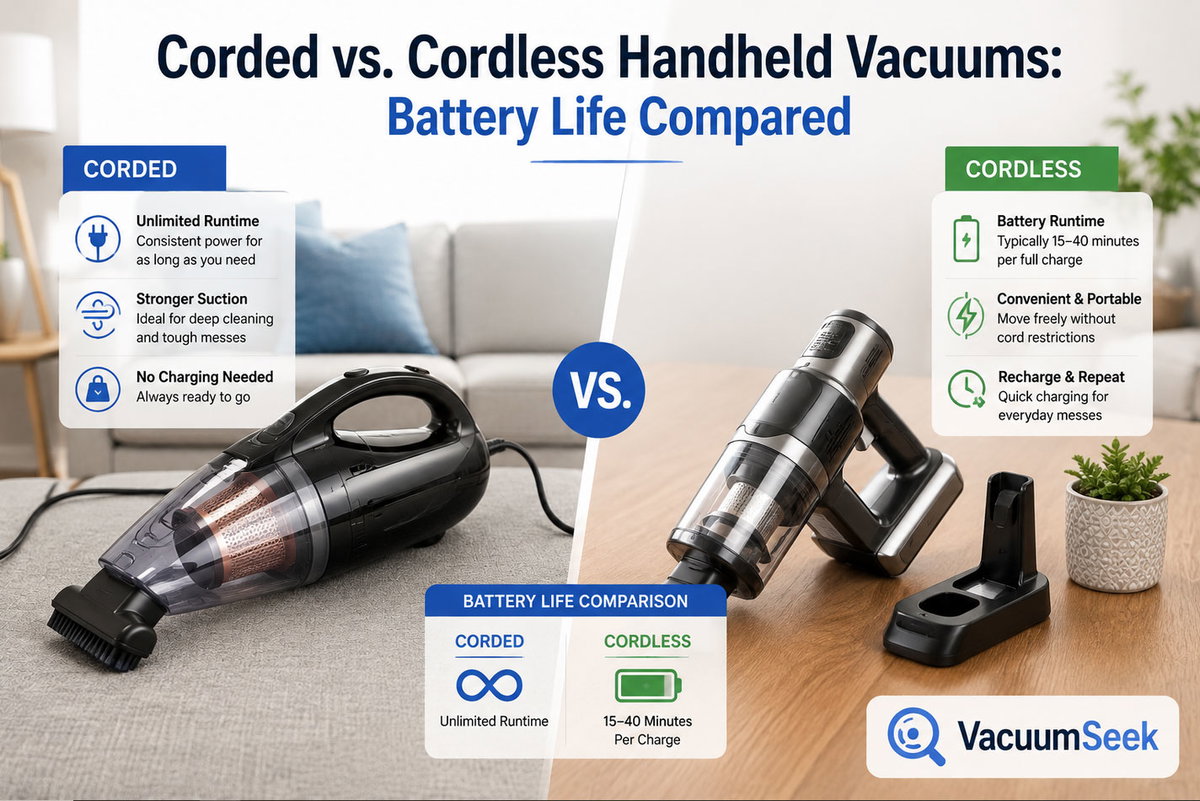
Every handheld vacuum buyer eventually asks the same question at the checkout screen, usually with a cursor hovering between two nearly identical-looking products: does the battery actually last, or is that runtime number just marketing math? It's a fair thing to wonder. Handheld vacuums live in the gap between "quick cleanup tool" and "serious cleaning appliance," and battery life is the one spec that decides which one you actually get.
Corded models solve the problem by refusing to have a battery at all. Plug in, vacuum, done — no countdown clock, no fading suction halfway through the car interior. Cordless models solve a different problem: freedom from outlets, at the cost of a finite, decaying, mode-dependent runtime that manufacturers describe in the most flattering light possible. Neither approach is objectively better. They're built around different trade-offs, and the right one depends on what you're cleaning, how often, and how much you're willing to babysit a charger.
This piece breaks down exactly how battery life differs between corded and cordless handheld vacuums, what actually eats into runtime in real-world use, and how to figure out which category fits your home.
The Real Question Isn't Power, It's Endurance
It's tempting to frame this debate around suction strength, since that's the number brands put in bold on the box. But suction is a corded-vacuum advantage almost by default — a wall outlet delivers a steady, unlimited stream of electricity, so corded handhelds don't need to ration power. Cordless models have to make a harder choice: sip the battery slowly for long runtime, or drain it fast for strong suction. That single design constraint explains nearly every functional difference between the two categories, including the multiple "modes" you'll find on almost every cordless model today.
So the more useful lens isn't "which one sucks harder," it's "which one keeps working long enough to finish the job." A vacuum with incredible suction that dies four minutes into vacuuming a minivan isn't actually more useful than a weaker one that runs the whole time. Endurance, not peak power, is what determines whether a handheld vacuum earns a permanent spot in your closet or ends up as a drawer ornament.
How Vacuum Batteries Actually Work
Nearly every cordless handheld vacuum sold today runs on lithium-ion battery packs, the same chemistry found in laptops and power tools. Lithium-ion replaced the older nickel-cadmium and nickel-metal-hydride batteries that used to power cordless cleaning tools because it holds more energy per gram, doesn't suffer badly from "memory effect" (where a battery starts remembering a shorter charge if it's not fully drained each cycle), and degrades more gracefully over time.
Why Voltage and Amp-Hours Matter More Than Marketing Claims
Two numbers actually predict performance, and neither of them is the word "minutes" printed on the packaging:
- Voltage roughly correlates with suction power. Higher-voltage batteries (typically in the 20V–25V range for premium handhelds) can drive stronger motors.
- Amp-hours (Ah), or milliamp-hours (mAh), measure how much total energy the battery stores — this is the number that actually determines runtime at a given power draw.
A vacuum can advertise "up to 60 minutes" and be telling the truth, while also being almost useless for the kind of cleaning you actually want to do, because that number was measured on the lowest suction setting with no attachment installed. Understanding this is the difference between choosing a vacuum that meets your expectations and choosing one that quietly disappoints you in week two.
Corded Handheld Vacuums: The Case for Infinite Runtime
Corded handheld vacuums are the older, simpler technology, and in some ways that's exactly their appeal. There's no battery to degrade, no runtime clock, and no mode dial forcing you to trade power for time.
Advantages
- Unlimited runtime. As long as it's plugged in, it runs — full stop. There's no calculating whether you have enough charge left to finish the stairs.
- Consistent suction throughout use. Corded motors don't taper off as a battery depletes, so the last minute of cleaning is as strong as the first.
- No battery replacement costs. Cordless vacuum batteries degrade after roughly 300–500 charge cycles, and replacements can cost a meaningful fraction of the vacuum's original price. Corded models sidestep that expense entirely.
- Lower upfront price, generally. Without a battery, motor-management electronics, or charging dock to engineer, corded handhelds tend to sit at the budget end of the category.
The Trade-Offs
- You're tethered to an outlet, which makes cleaning a car, a staircase, or a garage genuinely inconvenient — sometimes requiring an extension cord.
- Cord management becomes its own chore. Wrapping, unwrapping, and untangling a cord adds friction to a task that's supposed to be quick.
- Mobility is capped by cord length, usually somewhere between 15 and 20 feet, which isn't always enough for larger vehicles or rooms far from a socket.
Corded handhelds tend to earn loyalty from people who use them in one predictable spot — a kitchen for daily crumb patrol, a workshop near a bench outlet — where cord limitations barely register.
Cordless Handheld Vacuums: Freedom That Runs on a Timer
Cordless handhelds solved the tethering problem and, in doing so, created a new one: everything about their performance now depends on a battery that's slowly, invisibly draining from the moment you unplug it from the charger — and slowly, invisibly aging with every charge cycle it survives.
Advantages
- Total mobility. No outlet-hunting, no cord snagging on furniture legs, no limits on where you can clean.
- Faster for spot cleaning. Grab-and-go convenience makes cordless handhelds better suited to the "oh no, spilled cereal" moments that don't justify unwinding a cord.
- Multiple power modes let you choose between longer runtime and stronger suction depending on the job.
The Trade-Offs
- Runtime is finite and mode-dependent, often ranging from as little as 5 minutes on the strongest setting to around an hour on the weakest.
- Suction fades as the battery drains, particularly in the final 10–15% of charge, so the end of a cleaning session is rarely as strong as the start.
- Batteries degrade permanently over time. A battery that delivered 40 minutes on day one might deliver 25–30 minutes after a year or two of regular use.
- Charging takes far longer than the runtime it produces — a pattern explored in more detail below.
Battery Life Compared: What the Numbers Actually Say
Marketing runtime figures are technically accurate but frequently measured under best-case conditions: lowest suction setting, no motorized brush attached, brand-new battery. Real-world runtime — especially with a motorized brush head engaged on carpet or upholstery — typically lands well below the advertised ceiling. The table below lays out how corded and cordless handhelds actually compare across the factors that matter.
| Factor | Corded Handheld Vacuum | Cordless Handheld Vacuum |
|---|---|---|
| Runtime | Unlimited (while plugged in) | Typically 5–60 minutes, depending on power mode |
| Suction consistency | Constant from start to finish | Peaks at full charge, tapers as battery drains |
| High-power mode runtime | Not applicable — full power always available | Often just 5–15 minutes on max suction |
| Eco/low-power mode runtime | Not applicable | Often 40–60 minutes, with reduced suction |
| Charging time (full battery) | None required | Roughly 3–5 hours for a full charge on most models |
| Battery lifespan | No battery to degrade | Roughly 300–500 charge cycles (2–4 years of typical use) before noticeable capacity loss |
| Mobility | Limited by cord length (~15–20 ft) | Unlimited, anywhere in the home or car |
| Upfront cost | Generally lower | Generally higher |
| Long-term cost | Lower (no battery replacement) | Higher (eventual battery or unit replacement) |
| Best for | Fixed cleaning zones, long sessions, daily heavy use | Mobile cleanup, cars, stairs, quick jobs |
A useful real-world reference point: premium cordless handhelds like the Dyson V15 in handheld mode advertise up to roughly 60 minutes on the lowest suction setting, but that figure drops to somewhere in the 5–15 minute range on the highest setting — a gap confirmed by independent testing at outlets like TechRadar. Mid-range cordless models from brands like Shark follow a similar pattern, with official specs from Shark showing comparable spreads between eco and boost modes. Corded models don't appear in this kind of table at all, because "runtime" isn't a spec that applies to them.
What Really Drains a Cordless Battery Faster Than the Spec Sheet Suggests
Runtime numbers assume ideal conditions, and few real cleaning sessions are ideal. Several factors quietly shorten actual battery life well below what's printed on the box:
- Motorized attachments. A powered brush roll or mini turbo tool draws significantly more current than a bare crevice tool, cutting runtime substantially.
- Suction mode selection. Boost or max modes can drain a battery five to ten times faster than eco mode.
- Surface type. Dense carpet and upholstery force the motor to work harder than hard flooring, drawing more power per minute of use.
- Battery age. Lithium-ion cells lose a portion of their maximum capacity with every charge cycle, so a two-year-old vacuum simply can't match its day-one runtime, even in the identical mode.
- Temperature. Charging or storing a cordless vacuum in a cold garage or hot attic can measurably reduce both charge capacity and cycle lifespan, a pattern well documented by battery-care resources like Consumer Reports.
- Partial charging habits. While lithium-ion doesn't suffer the severe "memory effect" of older battery chemistries, consistently running a battery to zero before recharging still accelerates long-term wear.
None of this makes cordless vacuums unreliable — it just means the number on the box is a ceiling, not a guarantee.
Charging Time vs. Cleaning Time: The Hidden Math Nobody Talks About
Here's the part of the battery-life conversation that rarely makes it onto a spec sheet: cordless handheld vacuums typically take three to five hours to fully recharge, yet deliver anywhere from five minutes to an hour of actual runtime depending on mode. That's a charge-to-use ratio that can run as high as 30-to-1 in high-power mode. A corded vacuum's "charge time" is zero, because it never stops being powered.
This matters most for households that clean in bursts — a spilled bag of flour, a muddy dog, a car that needs detailing before a road trip — because a depleted cordless vacuum isn't back in action for hours, while a corded one is ready the instant it's plugged back in. Some premium cordless models address this with swappable battery packs, letting you keep a charged spare on hand, but that adds cost and is really a workaround for the underlying limitation rather than a fix for it. Outlets like Wirecutter have flagged battery swap capability as one of the more meaningful differentiators between otherwise similar cordless models for exactly this reason.
Where Corded Wins, Where Cordless Wins
Neither format is universally correct — they're suited to different cleaning patterns.
When Corded Wins
- You clean the same fixed area repeatedly (a kitchen near an outlet, a workshop bench).
- You do long, thorough cleaning sessions rather than quick touch-ups.
- You want to avoid ever thinking about battery replacement or degradation.
- Budget is the deciding factor and you don't need portability.
When Cordless Wins
- You clean cars, stairs, upholstery, or rooms without convenient outlets.
- Your cleaning sessions are short and frequent rather than long and occasional.
- You value grab-and-go convenience over raw runtime.
- You're willing to manage charging as part of your routine, the way you would with a phone.
Plenty of households end up owning both — a corded model parked in the kitchen for daily crumb duty, and a cordless one in the garage or trunk for the jobs a cord simply can't reach.
Battery Degradation: What Your Vacuum Won't Tell You After Year Two
Every lithium-ion battery has a finite number of full charge cycles before its maximum capacity starts noticeably shrinking — generally somewhere in the 300 to 500 cycle range for the batteries used in handheld vacuums, according to battery-life research summarized by outlets including CNET. For a vacuum used two or three times a week, that translates to roughly two to four years before runtime drops noticeably, even though the vacuum itself may still work perfectly otherwise.
This is the part of the ownership cost that rarely factors into the initial purchase decision. A cordless handheld that runs 45 minutes on eco mode when new might only manage 25–30 minutes after two years of typical use. Replacement batteries are available for most major brands, but pricing varies widely, and on lower-cost models, a new battery can approach the cost of buying a new vacuum outright — worth checking before you buy, not after the runtime starts disappointing you.
Corded vacuums simply don't have this problem. Their main components — motor, cord, filter — degrade far more slowly and predictably, which is part of why some corded handhelds from decades ago are still functioning in garages and utility closets today.
Five Habits That Actually Extend Cordless Battery Life
For anyone who's already committed to cordless, a few habits meaningfully slow down battery degradation:
- Avoid full discharges when possible. Recharging from 20–30% remaining puts less cumulative stress on the cells than routinely running to zero.
- Store at moderate temperatures. Avoid leaving the vacuum in a hot car, garage, or attic for extended periods.
- Use lower power modes for routine cleaning, saving boost mode for genuinely tough spots.
- Don't leave it on the charger indefinitely once fully charged, particularly with older charging docks that lack smart cutoff features.
- Clean the filter and bin regularly. A clogged filter forces the motor to work harder for the same suction, draining the battery faster than necessary.
The Verdict: Which One Should You Buy?
If the honest answer is that you want a single vacuum that never leaves you second-guessing whether it'll finish the job, and you're cleaning the same spot most of the time, a corded handheld remains the more dependable choice — not the flashier one, but the one that won't quietly lose 30% of its stamina by its second birthday.
If your cleaning happens in the car, on the stairs, or in short unpredictable bursts throughout the week, cordless is worth the trade-off, as long as you go in with realistic expectations about mode-dependent runtime and budget for an eventual battery replacement.
The honest middle-ground answer, and the one most professional reviewers including Good Housekeeping tend to land on, is that battery life shouldn't be evaluated in isolation. It should be weighed against how, where, and how often you actually plan to clean — because the "best" handheld vacuum on paper is worthless if its runtime doesn't match your real routine.
Frequently Asked Questions
Do cordless handheld vacuums lose suction as the battery drains? Yes. Most cordless models show a gradual drop in suction power as the battery depletes, with the most noticeable decline in the final 10–15% of charge. Corded vacuums maintain constant suction throughout use since they draw directly from an outlet.
How long do handheld vacuum batteries typically last before needing replacement? Most lithium-ion vacuum batteries handle roughly 300 to 500 full charge cycles before capacity noticeably declines — typically two to four years for a vacuum used a few times per week.
Is a corded handheld vacuum more powerful than a cordless one? Generally, yes, on a sustained basis. Corded models draw unlimited power from the outlet, while cordless models must balance suction strength against battery drain, which is why most offer selectable power modes.
Can I replace the battery in a cordless handheld vacuum instead of buying a new one? On most major-brand models, yes — replacement batteries are sold directly by manufacturers or third-party suppliers. Pricing varies significantly, so it's worth checking replacement battery cost before purchasing a budget cordless model.
Which type is better for cleaning a car? Cordless, almost universally, since most cars aren't parked near an outlet and a cord long enough to reach every seat and trunk corner isn't practical.
The corded-versus-cordless decision ultimately isn't about which technology is newer or more impressive — it's about matching a vacuum's power delivery to the way you actually clean. Runtime numbers on a box are a starting point, not a promise, and the vacuum that "wins" is simply the one still working when you need it to be.