
Essential Vacuum Attachments for Hardwood Floor Care
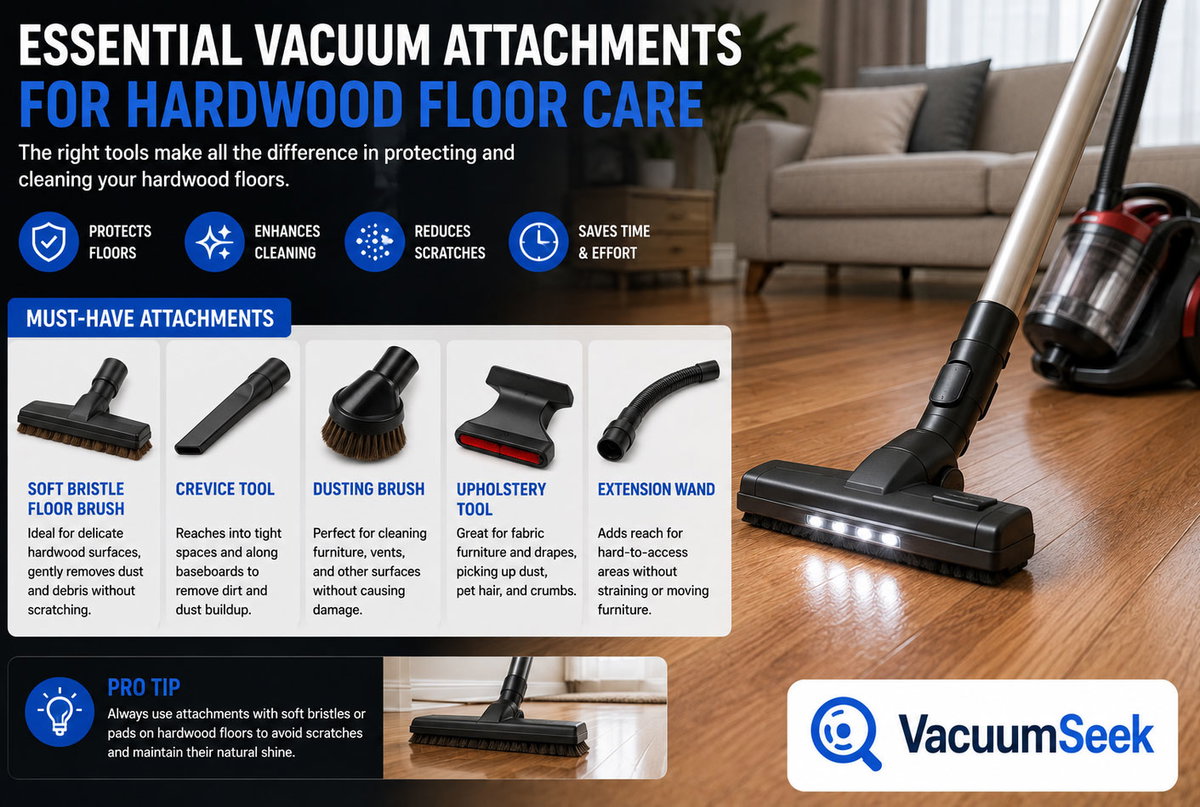
Hardwood floors forgive very little. A dropped bristle, a stray wheel, a beater bar left spinning against the grain for even ten seconds — any of these can leave a mark that no amount of polish will fully erase. And yet most people vacuum their hardwood the same way they vacuum everything else: same head, same setting, same rushed pass from the doorway to the far wall. The floor tolerates it, mostly, until one day it doesn't.
The fix isn't a better vacuum. It's better attachments, used with a little more intention. This guide walks through the specific tools that protect wood while actually lifting the dust, grit, and pet hair that dull a finish over time — plus where to find trustworthy guidance if you want to go deeper than a single article can take you.
Quick Answer: The Attachments That Matter Most
For readers who want the short version before the long one: a soft-bristle floor brush (dusting brush), a crevice tool, an upholstery or dusting brush for baseboards, and — if your vacuum has one — a hardwood-specific floor head with felt or microfiber pads cover roughly 90% of what a hardwood floor actually needs. A motorized beater-bar brushroll should never touch bare wood. Everything below explains why, and what to reach for in the other 10% of situations: stair edges, wide seams, area rug borders, and rooms where allergy control matters as much as shine.
Why Hardwood Floors Need a Different Approach Than Carpet
Carpet vacuums are engineered to fight friction. Fibers grab dirt and hold it, so manufacturers build brushrolls that agitate the pile, dig into it, and pull embedded grit up and out. That's the entire design philosophy behind a rotating beater bar: aggressive contact, high RPM, bristles or rubber fins that dig in.
None of that belongs on a finished wood surface. Hardwood doesn't hide dirt the way carpet does — it sits on top, loose, waiting to be dragged across the finish by whatever touches it next. A rotating brush loaded with grit acts like a very slow belt sander every time you push the vacuum forward. Do that daily for a year and the microscratches add up into the hazy, dull look many homeowners mistake for "the floor just getting old." It isn't age. It's the wrong tool, repeated.
The other issue is suction control. Standard carpet settings pull hard enough to seat the vacuum head against the fibers and hold it there, which is exactly what you want on plush carpet and exactly what you don't want on a floor. Suction that's too aggressive on bare wood can fling small hard debris — sand, gravel, pet litter — sideways across the finish rather than lifting it cleanly into the canister, scattering scratches instead of preventing them.
Attachments solve both problems at once: they swap contact-based agitation for suction-based lifting, and they let you dial cleaning pressure to the surface instead of forcing the surface to survive whatever the vacuum was built for.
The Soft Bristle Floor Brush: The One Attachment You Actually Need Every Day
If a hardwood-owning household keeps exactly one attachment on hand, it should be this one. Sometimes labeled a "hard floor brush," "dusting brush," or "parquet brush," it swaps the rotating bar for a fixed row of soft, densely packed bristles — natural fiber, horsehair blend, or fine synthetic — arranged to sweep dust into the airflow rather than grind it into the finish.
A few things separate a good one from a mediocre one:
- Bristle density matters more than bristle softness alone. Sparse bristles let fine dust skip past them; a dense row sweeps it forward into the suction path.
- Width should roughly match your widest room. A too-narrow head means more passes, more edge contact, more opportunity to nick a baseboard.
- Swivel neck design helps the head stay flat against the floor through turns, rather than tilting and dragging a corner across the finish.
Used correctly — light, even pressure, overlapping passes, no back-and-forth scrubbing motion — this single attachment handles daily dust, pet hair, and the fine grit that regular foot traffic drags in from outside. It's the wood-floor equivalent of a soft-bristle broom, except it actually captures what it collects instead of just relocating it.
Crevice Tools: Small, Narrow, and Underrated
The crevice tool is the long, flat, tapered nozzle every vacuum kit includes and almost nobody uses on purpose. On hardwood, it earns its place for the spaces a wide brush head physically cannot reach:
- The seam where flooring meets the baseboard, where dust, hair, and skin cells collect in a thin gray line
- Between floorboards themselves, particularly in older or wide-plank floors where seams have widened slightly with seasonal humidity changes
- Along heating vents and radiator edges set into or near the floor
- Under the lip of built-in cabinetry, bookshelves, and kick plates
Because the opening is narrow, suction concentrates rather than dilutes, which makes this the right tool for compacted debris in tight lines — but it's also the easiest attachment to misuse. The plastic tip, if pressed edge-on into a finish rather than run flat along a seam, can leave a fine scratch. Angle it so the flat side, not the point, contacts the wood, and let the suction do the lifting rather than pressing down.
The Dusting Brush for Baseboards, Trim, and Furniture Legs
A slightly different tool from the floor brush above, the dusting brush is smaller, rounder, and meant for vertical and low-lying surfaces rather than open floor. It matters to hardwood care specifically because baseboards shed dust onto the floor constantly — cleaning the floor without cleaning the trim just means redepositing the same dust an hour later.
Run it along baseboards, window sills, and the legs of wood furniture sitting on the floor. Many models thread onto the same wand as the crevice tool, so switching between them mid-room takes seconds rather than a full attachment change.
Felt or Microfiber Floor Heads: Purpose-Built for Bare Wood
Higher-end vacuum lines — particularly canister and stick vacuums marketed specifically for hard floors — now include a dedicated floor head with a felt, microfiber, or velvet-lined base instead of bristles at all. These work almost like a powered dust mop: the soft material glides across the finish, picking up fine particulate through static and gentle contact while the vacuum's airflow handles the heavier debris underneath.
This category is worth the investment for households with a lot of open hardwood square footage, because it's genuinely faster than a bristle brush for daily maintenance and gentler than almost anything else on the market. The tradeoff is that felt and microfiber pads need regular washing or replacement — a soiled pad just redistributes dust rather than lifting it, defeating the purpose.
Miele, one of the manufacturers most associated with this attachment category, sells several parquet-specific floor heads compatible across its canister vacuum lines. Their U.S. operations are headquartered at 9 Independence Way, Princeton, NJ 08540, with an on-site Experience Center where hardwood-specific attachments can be seen and tested in person before buying — useful if you want to feel the bristle stiffness or pad texture rather than judge it from a product photo. Their consumer site is mieleusa.com.
The Attachment You Should Actively Avoid: The Motorized Beater Bar
This deserves its own heading because it's the single most common source of accidental hardwood damage from vacuuming. The motorized brushroll — the spinning bar with bristles, rubber fins, or a combination of both — exists to agitate carpet fiber. On bare wood, it does three things, none of them good:
- It drags trapped grit across the finish at the brush's full rotational speed, rather than lifting the grit cleanly away from the surface.
- It can gouge or dull the finish through direct bristle contact, especially on vacuums where the roller height isn't adjustable or is set for carpet pile.
- It can catch and fling loose items — area rug fringe, cord ends, small debris — creating a secondary damage risk beyond the floor itself.
Most modern vacuums marketed as "multi-surface" include a switch, sensor, or separate head to disable or swap out the brushroll for hard floors. Learn where that control is on your specific machine and use it every single time, not just when you remember. If your vacuum has no such option and no interchangeable head, that's the strongest possible argument for buying a dedicated hard-floor attachment rather than trusting the default setting.
HEPA Filtration Attachments and Why Hardwood Owners Should Care
Hardwood floors don't trap allergens the way carpet does — that's usually cited as a benefit — but it cuts both ways. Whatever settles on hardwood stays loose and airborne-ready, meaning a low-quality vacuum without proper filtration can kick fine dust and allergens back into the room through its exhaust even as it appears to be cleaning the floor.
A HEPA filter attachment or built-in HEPA filtration system matters more on hardwood than people expect, precisely because there's no fiber layer trapping particles between cleanings. For households managing allergies or asthma, this is not a cosmetic upgrade — it's the difference between a vacuum that removes allergens and one that redistributes them.
The Asthma and Allergy Foundation of America, headquartered in Arlington, Virginia, publishes independent guidance on vacuum filtration and indoor allergen control that's worth reading before choosing a model; find it at aafa.org. The U.S. Environmental Protection Agency also maintains general indoor air quality resources relevant to household dust and filtration at epa.gov/indoor-air-quality-iaq.
Handheld and Cordless Attachment Kits: Stairs, Runners, and Rug Edges
Hardwood rarely exists in isolation. Stairs, area rug borders, and transition strips between rooms all sit at the edges of a wood floor, and they need a different handling approach than the open field of a living room.
A handheld or cordless attachment, paired with a small dusting brush, is the right tool for:
- Stair treads and risers, where a full-size floor head simply can't maneuver
- The border where an area rug meets exposed hardwood, a spot that collects a disproportionate amount of grit as foot traffic crosses on and off the rug
- Transition strips and thresholds, often slightly raised, where a wide head can catch and scuff the edge
Cordless stick vacuums with a detachable handheld unit have made this significantly easier over the last several years, since the same battery and motor can switch from full-room cleaning to spot work without swapping the whole machine.
Crevice and Grout-Style Tools for Wide-Plank and Reclaimed Wood
Wide-plank and reclaimed hardwood — increasingly common in renovation projects — often have more pronounced, sometimes irregular seams between boards than factory-milled strip flooring. Standard crevice tools work, but a narrow, angled brush attachment, sometimes sold for tile grout lines, can be more effective for seams with texture or slight unevenness, since the bristles reach into the seam rather than skating across the top of it.
This is a smaller-audience attachment, but for anyone with century-old reclaimed flooring or hand-scraped boards, it solves a real problem that a standard crevice nozzle handles only partially.
Choosing Attachments by Brand: What's Actually Compatible
Attachment compatibility is where a lot of hardwood-owning households lose money, buying a beautiful soft-bristle head that simply doesn't fit their machine. A few notes worth knowing before purchasing:
- Miele canister vacuums use a largely standardized wand and hose diameter across recent model years, making aftermarket and cross-generation attachments more interchangeable than most brands. Details on current attachment compatibility are listed at mieleusa.com.
- SharkNinja, headquartered at 89 A Street, Needham, MA 02494, produces both the Shark and Ninja lines, and its hard-floor attachments are generally specific to each vacuum generation rather than universal — worth checking the exact model number before buying a replacement head. Product and attachment listings are at sharkninja.com.
- Dyson cordless stick vacuums use a proprietary click-fit attachment system that's consistent across most of the current lineup, so a soft-roller or fluffy cleaner head bought for one recent model usually fits others in the same generation. Compatibility details are at dyson.com.
When in doubt, match by model number rather than by vacuum "type" — two vacuums that look nearly identical can use entirely different wand diameters.
What the Flooring Industry Actually Recommends
Independent, non-manufacturer guidance is worth seeking out here, since vacuum brands have an obvious incentive to recommend their own attachment ecosystem. The National Wood Flooring Association (NWFA), the leading trade and standards body for hardwood flooring in North America, publishes maintenance guidance that isn't tied to any single vacuum brand. Their office is located at 14 Research Park Drive, St. Charles, MO 63304, and their full care and maintenance resources are available at nwfa.org.
Their general position lines up with everything above: soft, non-abrasive attachments; suction-based rather than agitation-based cleaning on bare wood; and a beater-bar brush reserved strictly for carpeted or rugged areas, never disengaged and dragged across finished flooring by accident.
Upright, Canister, or Stick: Which Base Vacuum Actually Suits These Attachments
The attachment matters more than the vacuum body, but the body determines how easily you'll actually use the right attachment instead of skipping it.
Canister vacuums tend to be the most attachment-friendly for hardwood specifically. The motor unit stays separate from the floor head, connected by a hose and wand, which means swapping between a soft brush, crevice tool, and dusting brush takes seconds and doesn't require lifting or repositioning a heavy body. This is part of why canister models remain popular among flooring professionals and in households with large expanses of bare wood.
Upright vacuums have improved significantly on this front, with many current models offering a floor-type switch or a dedicated hard-floor head that clips onto the same body. The tradeoff is weight and maneuverability — an upright designed primarily for carpet can feel cumbersome when you're trying to work a crevice tool into a tight baseboard seam, simply because the whole unit has to come along for the movement.
Cordless stick vacuums have become the most practical option for mixed flooring homes, largely because the detachable handheld unit doubles as the attachment base for stairs, rug edges, and furniture legs without needing a second device. Battery life is the real constraint here — a full attachment rotation across a large home can eat into runtime faster than expected, so it's worth checking real-world battery figures rather than the manufacturer's best-case number.
None of these is objectively correct. A household with mostly open-plan hardwood and few obstacles will get the most out of a canister's easy attachment swaps. A household with a lot of stairs, rugs, and furniture legs will likely lean on a cordless stick vacuum's handheld mode more than either of the others.
A Simple Weekly Rotation
Rather than treating every cleaning session identically, most hardwood floors do best with a rotation like this:
- Daily or every other day: Soft bristle floor brush over open areas, dusting brush along baseboards.
- Twice weekly: Crevice tool along seams, transitions, and vent edges.
- Weekly: Handheld attachment for stairs and rug borders; check and empty or wash the HEPA filter if the canister is more than half full.
- Monthly: Inspect the felt or microfiber pad (if your vacuum uses one) for wear, and confirm the beater bar, if the vacuum has one, is fully disengaged or swapped out before the next hardwood pass.
This isn't a rigid schedule so much as a reminder that different attachments earn different frequencies — the soft brush does the heavy lifting daily, while the specialty tools fill in the gaps weekly or monthly rather than every session.
Common Mistakes Worth Naming Directly
A few patterns show up again and again in how people damage hardwood with a vacuum, and most are easy to fix once named:
- Leaving the brushroll engaged "just for this one room." It only takes one pass with grit underneath to leave a mark.
- Using a full-size floor brush on stairs, where it can't sit flat and ends up scraping edges instead of sweeping them.
- Ignoring pad and filter maintenance. A dirty felt pad or clogged HEPA filter doesn't clean less — it actively smears dust back onto the surface it just passed over.
- Assuming "hardwood setting" on a vacuum's dial is equivalent to a proper attachment swap. Some settings only reduce suction; they don't disengage brush contact. Check the manual rather than trusting the label.
Final Thoughts
None of this requires an expensive vacuum overhaul. Most households already own a crevice tool and a dusting brush somewhere in a drawer or clipped to the vacuum body, unused since the day the machine was unboxed. The real shift is behavioral: reaching for the right attachment before starting, rather than defaulting to whatever head happens to already be on the vacuum.
Hardwood floors reward that small discipline. A finish maintained with the right attachments for a decade looks meaningfully different from one cleaned carelessly for the same span of time — not because of one dramatic mistake, but because of a thousand small ones that never happened.
Frequently Asked Questions
Can I use a regular carpet vacuum attachment on hardwood floors? Only the non-motorized ones — crevice tools, dusting brushes, and upholstery attachments are generally safe on hardwood. Avoid any attachment with a spinning brushroll or rigid plastic edge designed for carpet pile.
Is a robot vacuum safe for hardwood floors without special attachments? Most robot vacuums use rubber or silicone rolling brushes rather than rigid bristle beater bars, which is gentler on wood, but check the manufacturer's floor-type settings and confirm suction and brush speed are appropriate for bare wood rather than left on a universal default.
How often should I replace a felt or microfiber vacuum pad? Wash reusable pads after every few uses and replace them when the material thins or the fibers flatten, typically every few months with regular use — a worn pad loses its dust-lifting ability well before it looks visibly dirty.
Do I need a HEPA filter attachment specifically for hardwood floors? It's not mandatory, but it matters more than many assume, since hardwood has no fiber layer trapping allergens between cleanings. Anyone managing allergies or asthma in the household will generally benefit more from HEPA filtration on hardwood than on carpet, where some particulate stays trapped regardless.
What's the single biggest attachment mistake people make on hardwood? Leaving the motorized beater bar engaged. It's built for carpet agitation, and even a few seconds of contact with grit underneath can leave fine scratches across a finish.