
HEPA Filters Explained: Which Vacuums Actually Help with Allergies
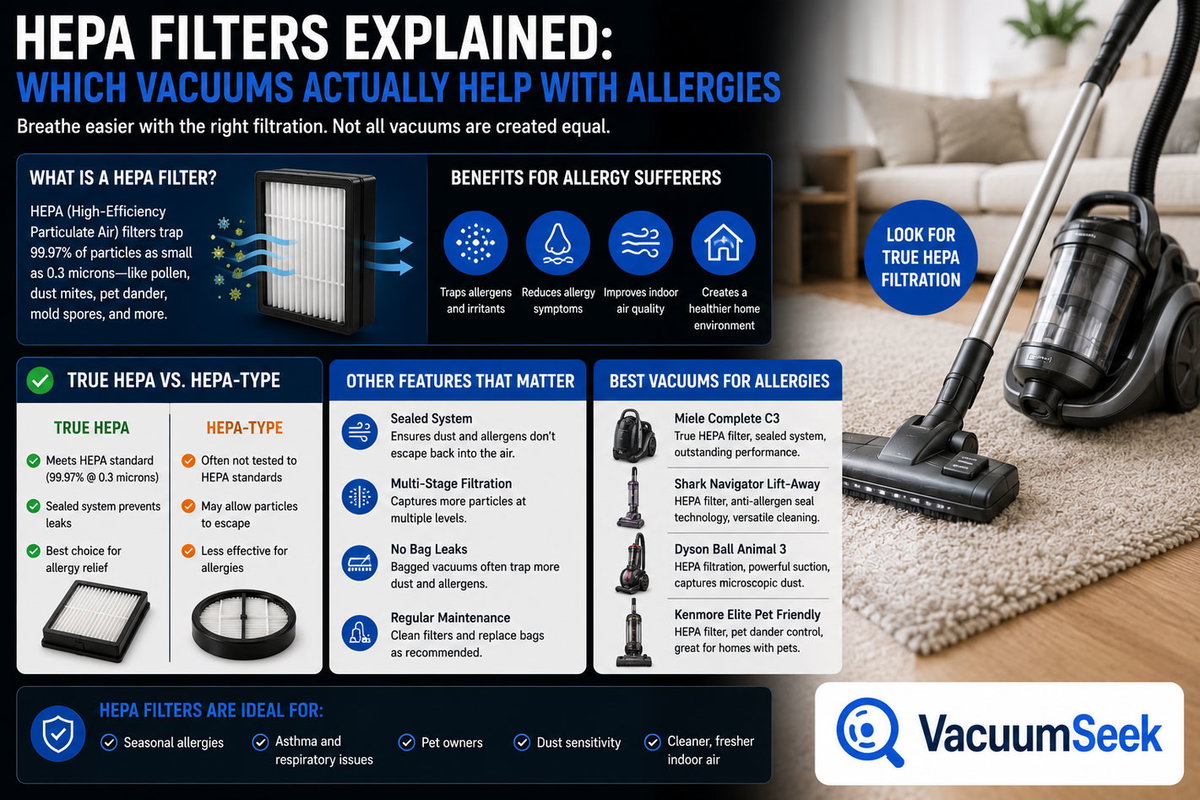
Every vacuum box at the store claims to fight allergies. Somewhere on the packaging, in a font just big enough to catch your eye, sits the word "HEPA," usually paired with a photo of someone breathing easy in a sunlit living room. What the box rarely tells you is that HEPA is a legal standard, not a guarantee — and that a vacuum can carry a genuine HEPA filter and still make your allergies worse. The difference between a vacuum that helps and one that just moves dust around comes down to a handful of engineering details that marketing copy tends to skip. This piece walks through what those details are, which ones actually matter for allergy sufferers, and which vacuums back up their claims with real filtration rather than a sticker.
What HEPA Actually Means (And What the Letters Don't Promise)
HEPA stands for High Efficiency Particulate Air, and it isn't a brand — it's a performance threshold defined by the U.S. Department of Energy. According to the EPA, a true HEPA filter can theoretically remove at least 99.97% of dust, pollen, mold, bacteria, and other airborne particles with a size of 0.3 microns. That specific size isn't arbitrary. Particles around 0.3 microns are known in filtration science as the Most Penetrating Particle Size, because particles that fall between roughly 0.2 and 0.3 microns are the hardest for any filter to capture — smaller particles get caught by diffusion, larger ones by direct impact, but this in-between size slips through more easily than either extreme. That means the 99.97% figure represents a filter's worst-case performance. Everything larger or smaller than 0.3 microns is trapped at an even higher rate.
For allergy sufferers, this matters more than it sounds. Pollen grains typically run 10 to 100 microns. Pet dander ranges from about 5 to 100 microns. Dust mite fecal particles, the primary trigger in dust mite allergy, are usually 10 to 40 microns. All of these are dramatically larger than the 0.3-micron benchmark HEPA is tested against, which means a genuine HEPA filter isn't just adequate for common household allergens — it's overbuilt for them, catching them well before they'd ever challenge the filter's limits.
The catch is the word "genuine." Nothing about the letters H-E-P-A is legally protected the way, say, "organic" is on a food label in some markets. A manufacturer can print "HEPA-style" or "HEPA-like" on a box without the product ever being tested against that standard, and most shoppers won't notice the missing word.
The Marketing Trap: "True HEPA" vs. "HEPA-Type" vs. "HEPA-Like"
This is where a lot of allergy-motivated vacuum purchases go wrong. "True HEPA" is the phrase manufacturers use when a filter has actually been tested and certified to the 99.97%-at-0.3-microns standard. "HEPA-type," "HEPA-like," and "99% HEPA filtration" are softer claims that borrow the credibility of the term without the testing behind it. Some of these filters perform reasonably well. Others are closer to a standard pleated furnace filter with better branding. Because there's no enforcement mechanism forcing every vacuum maker to prove the claim, the burden falls on the shopper to look for the specific phrase "True HEPA" or a stated capture rate at 0.3 microns, and to be skeptical of anything vaguer.
A second, more technical wrinkle shows up on higher-end machines: the HEPA grading system borrowed from European standard EN 1822. Filters in this system are labeled H12, H13, or H14, and the letters tell you exactly how far past the baseline they go.
Reading the Fine Print: H12, H13, and H14 Ratings
Standard HEPA, the kind most home vacuums use, captures 99.97% of particles at 0.3 microns. But manufacturers targeting allergy and asthma sufferers specifically often step up to what's marketed as medical-grade or hospital-grade filtration. On the H-class scale, H12 captures 99.5% of particles, H13 captures 99.95%, and H14 captures 99.995% — each step removing a meaningfully larger share of the particles the previous grade let through. For most allergy sufferers dealing with pollen, dander, and dust mite debris, standard HEPA or H13 is more than sufficient. H14 filtration is typically reserved for cleanrooms, laboratories, and medical settings where near-total particle removal is the point, and it comes at a real cost in airflow resistance and price.
The practical takeaway: don't assume a higher letter automatically means a better vacuum for your situation. If you have moderate seasonal allergies, standard True HEPA already outperforms the size of the allergens you're dealing with. If you have severe asthma, chemical sensitivities, or are managing a household member undergoing treatment that requires an especially clean environment, an H13-rated machine is worth the premium. Chasing H14 for ordinary dust and pollen is usually paying for headroom you'll never use.
The Part Nobody Photographs: Sealed Systems
Here is the detail that separates vacuums that genuinely help allergy sufferers from vacuums that just have a HEPA filter sitting inside a leaky housing: the seal. A HEPA filter only filters air that actually passes through it. If the vacuum's body has gaps at the seams, around the dustbin lid, at the hose connection, or anywhere else air can escape, some portion of what the machine picks up bypasses the filter entirely and exits as a fine aerosol of exactly the particles you were trying to remove. Air moves along the path of least resistance, and an unsealed joint is far less resistant than a dense filter membrane.
This is why two vacuums can both say "HEPA filter" on the box and perform completely differently in a home with allergy sufferers. A sealed system is engineered so every joint and connection routes air through the filtration stack before it's expelled — nothing exits the machine without passing through the filter first. Miele markets this as its AirClean Sealed System, and Dyson achieves a similar result through whole-machine HEPA filtration built into a fully sealed body rather than a bolt-on filter cartridge. Both approaches solve the same underlying problem: a filter is only as good as the housing around it.
When you're shopping, look past the word "HEPA" in the spec sheet and search for the word "sealed." If a listing doesn't mention sealing the airflow path, assume it doesn't, and treat the HEPA claim with more caution.
Bagged or Bagless? The Allergy Sufferer's Dilemma
This is one of the more counterintuitive choices in the whole category. Bagless vacuums are more convenient and cheaper to run over time, but every time you empty a see-through bin, you're opening a chamber packed with concentrated allergens and giving them a direct route into the air you breathe — right at nose height, right before you walk away and forget about it. Bagged vacuums solve this by letting you seal the entire bag and toss it without ever touching the collected dust directly.
For someone with mild seasonal symptoms, this distinction may not be worth obsessing over. For someone with dust mite allergy, asthma, or a compromised respiratory system, it's genuinely one of the higher-leverage decisions in the whole purchase. A bagged canister vacuum with a sealed HEPA system, worn during use with a mask if symptoms are severe, minimizes every point of re-exposure — during vacuuming and during disposal. If you go bagless because of the convenience or cost savings, the least you can do is empty the bin outdoors, hold your breath while doing it, and empty it immediately rather than letting it sit full.
Why Particle Size Is the Whole Ballgame
It's worth slowing down on what your vacuum is actually up against, because the size of the target explains why filtration quality matters so much more than raw suction power for allergy purposes.
- Pollen grains run roughly 10–100 microns, visible under a basic microscope and, on the larger end, almost visible to the naked eye as a fine powder.
- Pet dander typically measures 5–100 microns, small enough to stay airborne for hours once disturbed.
- Dust mite fecal particles, the actual allergen in most dust mite reactions, run about 10–40 microns.
- Mold spores are smaller still, generally 2–10 microns, which makes them one of the harder common allergens to fully contain.
Every one of these is larger than the 0.3-micron benchmark HEPA is tested against, which is why a properly sealed True HEPA vacuum is genuinely effective against them — the filter isn't working near its limits, it's working with substantial margin to spare. The failure point in most homes isn't the filter media itself; it's everything around it: the seal, the maintenance schedule, and how the vacuum is used.
Which Vacuums Actually Help: Five Real Categories
Rather than chasing individual model numbers that change every product cycle, it's more useful to think in categories, since the engineering approach matters more than the badge on the front.
Third-party certified machines. The most direct shortcut available to shoppers is independent certification rather than a manufacturer's own claims. Sanitaire's EON Allergen upright, for instance, was the first commercial vacuum certified under the Asthma & Allergy Friendly Certification Program, built around a sealed HEPA system with a washable exhaust filter. Certified machines have been tested against a defined protocol rather than self-reported specs.
Sealed canister vacuums. Miele's canister line uses a fully sealed AirClean system paired with True HEPA filtration, and it's a recurring recommendation from allergy specialists precisely because the engineering closes the leakage gaps that undermine cheaper machines.
Bagged uprights with hospital-grade exhaust filtration. SEBO's line pairs a three-layer bag with an S-Class exhaust microfilter that meets HEPA standards by capturing 99.9% of fine particles down to 0.3 microns, combining the disposal advantage of a bag with sealed exhaust filtration.
Whole-machine HEPA cordless and upright models. Rather than bolting a HEPA cartridge onto an otherwise ordinary housing, some manufacturers, Dyson among them, build the entire body of the machine as the filtration path, so there's no separate seam where air can escape unfiltered.
Robot vacuums with auto-empty HEPA bins. For households that want to reduce allergen buildup between deep cleans without the physical exertion of manual vacuuming, self-emptying robots with HEPA-filtered base stations remove the human exposure step from bin disposal entirely, sealing collected dust into a bag at the station rather than a bin you handle yourself.
None of these categories require memorizing a specific model number that will be discontinued in eighteen months. What they share is the combination that actually matters: a certified or verifiably True HEPA filter, a sealed airflow path, and a disposal method that doesn't reintroduce what was just captured.
The Shortcut That Saves You Guesswork: Third-Party Certification
Given how loosely "HEPA" gets used in marketing, an independent certification mark is worth more than most spec sheets. The Asthma and Allergy Foundation of America partners with Allergy Standards Limited to run the Asthma & Allergy Friendly Certification Program, an independent testing program that evaluates household products, including vacuum cleaners, against strict standards before they're allowed to carry the certification mark. To earn it, a vacuum is assessed on its capability to remove allergen-containing dust from carpets, the amount of airborne allergen released during vacuuming, the integrity of its filtration system, and how much exposure occurs when changing the bag or emptying the bin. That last criterion is exactly the sealed-system and bagged-versus-bagless issue described above, tested rather than assumed.
AAFA, founded in 1953 and headquartered in the Arlington, Virginia area near Washington, D.C., is the same organization allergists routinely cite for consumer guidance, which gives its certification mark more weight than most retail badges. If a vacuum you're considering carries the Asthma & Allergy Friendly mark, that's a genuinely useful, independently verified signal — more reliable than any single line of marketing copy on the box.
Vacuuming Habits That Matter as Much as the Machine
Even the best-sealed, highest-rated HEPA vacuum won't help much if it's used badly. Allergists have fairly consistent guidance on this, and most of it costs nothing.
The American Academy of Allergy, Asthma & Immunology recommends weekly vacuuming with a HEPA-filtered or double-bagged machine to keep dust mite populations down, and notes that vacuuming inevitably stirs up settled allergens before the machine has a chance to capture them. Because of that, several allergist groups, including the American College of Allergy, Asthma & Immunology, recommend wearing an N95-rated dust mask while vacuuming if you're the one with allergies, or having someone else handle it instead. Slow, deliberate passes work significantly better than quick ones — several passes at walking pace lift more embedded dust than one fast sweep, since dust and allergen particles are worked loose from carpet fibers gradually rather than all at once. And it's worth staying out of a freshly vacuumed room for a stretch afterward, since disturbed dust genuinely does take time to resettle.
Filter maintenance matters more than most people expect, too. A clogged filter doesn't just lose suction — it increases the internal air pressure pushing air toward any weak seam in the housing, which is precisely the failure mode that undermines a sealed system. Replacing or washing filters on the manufacturer's schedule, and emptying bins or bags before they're completely full, keeps the sealed advantage intact rather than slowly eroding it.
Where a Vacuum Can't Save You
It's worth being honest about the limits here, because no vacuum, however well engineered, is a complete allergy solution on its own. Dust mites live primarily in mattresses, pillows, and upholstered furniture, and allergist guidance consistently ranks encasing mattresses, box springs, and pillows in allergen-proof covers ahead of any vacuum purchase for controlling dust mite exposure specifically. Bedding needs to be washed weekly in hot water regardless of how good your vacuum is. Central air systems benefit from their own filtration — the ACAAI's general guidance points toward a furnace or air conditioning filter with a MERV rating of 11 or 12, changed on a regular schedule, as a complement to floor cleaning rather than a substitute for it. A HEPA vacuum handles floors, carpets, and upholstery surfaces well. It does very little for what's already airborne by the time you're done cleaning, which is where a separate HEPA air purifier can pick up the slack, particularly in a bedroom.
Frequently Asked Questions
Does a HEPA filter alone make a vacuum good for allergies? No. The filter media is only one part of the system. Without a sealed housing that forces all air through the filter, unfiltered air can escape around the edges regardless of how good the filter itself is.
Is "HEPA-type" the same as "True HEPA"? No. "True HEPA" indicates the filter has been tested against the 99.97%-at-0.3-microns standard. "HEPA-type," "HEPA-like," and similar phrases are unregulated marketing terms that don't guarantee that testing was done.
Do I need an H13 HEPA filter, or is standard HEPA enough? For most allergy sufferers dealing with pollen, pet dander, and dust mites, standard True HEPA is sufficient, since all of those allergens are far larger than the particle size HEPA is tested against. H13 or higher is worth the added cost for severe asthma, chemical sensitivity, or medically fragile households.
Are bagged vacuums really better than bagless for allergies? For people with significant allergy or asthma symptoms, generally yes. A sealed bag can be disposed of without ever exposing you to the collected dust, while emptying a bagless bin releases a concentrated burst of allergens right as you're standing over it.
How often should I vacuum if someone in the house has allergies? Weekly for carpets and floors is the standard allergist recommendation, with more frequent vacuuming of mattresses and upholstered furniture if dust mites are a specific concern.
Is a robot vacuum with HEPA filtration a good option for allergy sufferers? It can be, particularly models with a self-emptying, HEPA-filtered base station, since they remove the manual bin-emptying exposure step entirely. They work best as a supplement to a more powerful manual vacuum for deep carpet cleaning rather than a full replacement.
The Bottom Line
A vacuum genuinely helps with allergies when three things are true at once: the filter is verifiably True HEPA rather than a softer marketing term, the housing is sealed so nothing bypasses that filter, and the disposal method doesn't undo the work by releasing everything back into the air. Suction power, brand reputation, and price all matter less than these three factors combined. When in doubt, an independent certification mark from a program like AAFA's is a faster, more reliable filter than reading between the lines of a spec sheet, and no machine replaces the basics — mattress encasements, hot-water laundering, and regular filter maintenance — that allergists have been recommending for decades.