
How Often Should You Vacuum Carpet? A Room-by-Room Guide
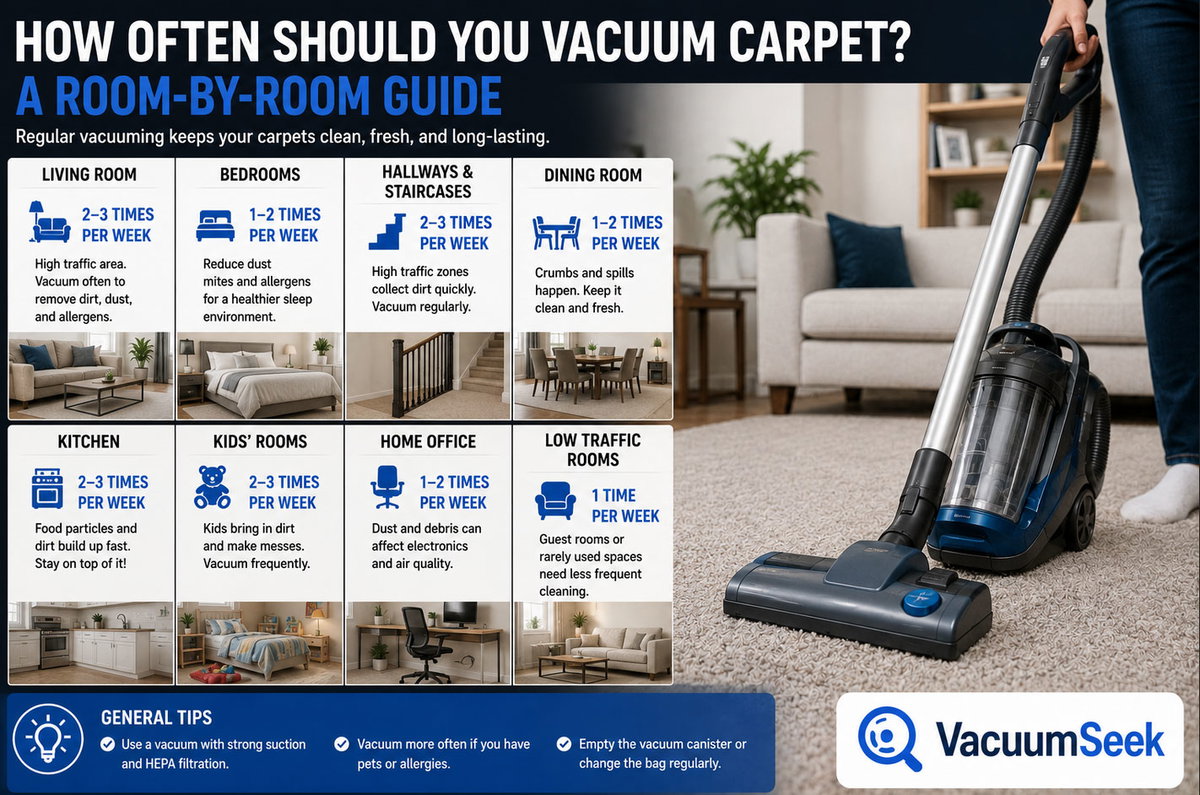
There's a version of this question that gets asked in every home goods store, every cleaning forum, and every group chat where someone just adopted a dog: how often do I actually need to vacuum? The honest answer is that "once a week" — the number most of us grew up with — is really a floor, not a formula. Some rooms need daily attention. Others can go a month between passes and nobody will notice. The right schedule depends on foot traffic, who and what lives in your house, and even the type of carpet under your feet.
This guide breaks vacuuming frequency down room by room, explains the reasoning behind each recommendation, and covers the special cases — pets, allergies, humidity, high-pile carpet — that push the numbers up or down. By the end, you'll have a schedule that fits your actual home instead of a generic rule that fits nobody's.
Why "Once a Week" Is Bad Advice for Most Homes
Carpet fibers work like a filter. Dirt, skin cells, pollen, and grit settle into the pile and stay there until something pulls them back out — usually a vacuum, sometimes a bare foot grinding them deeper. The Carpet and Rug Institute, the industry's leading standards body, puts it plainly: a weekly pass with a certified vacuum is a reasonable starting point, but how often an area actually needs vacuuming depends on how much it gets used. High-traffic zones and rooms with pets need attention daily, moderately used spaces need it about twice a week, and rooms that barely get walked through can stretch to once a week.
That sliding scale matters more than the single weekly number most people fixate on. A guest bedroom that hosts two visits a year is not the same maintenance problem as a mudroom hallway that absorbs every muddy boot in the household. Treating them identically means either over-cleaning a room nobody uses or, more commonly, under-cleaning the room that's quietly grinding dirt into its fibers every single day.
A few factors determine where any given room falls on that scale:
- Foot traffic volume — how many people (and paws) cross the carpet daily
- Household pets — shedding, dander, and tracked-in debris multiply cleaning needs
- Kids — crumbs, spills, and general chaos concentrate in certain rooms
- Allergy or asthma sufferers — dust mites and pet dander build up fastest in carpet, and the Mayo Clinic recommends low-pile carpeting vacuumed weekly with a HEPA-filter vacuum for anyone managing symptoms
- Carpet pile and age — dense, high-pile, or older carpet traps and hides dirt differently than short, tightly woven styles
- Climate and season — humid months and muddy seasons load carpet with more debris than dry winter stretches indoors
Once you factor those in, "how often should I vacuum" stops being one question and becomes ten smaller ones — one for every room in the house.
The Room-by-Room Vacuuming Guide
The Entryway and Front Hallway
This is the hardest-working carpet in your home, and it should be treated that way. Every shoe, paw, package, and gust of wind deposits something here before it ever reaches the rest of the house. If your entry has carpet or a carpeted runner, aim to vacuum it every day or every other day, especially during rainy or snowy stretches. A simple habit that cuts the workload: keep sturdy mats both outside and inside the door, and encourage shoes off at the threshold. The Carpet and Rug Institute lists this as one of the most effective ways to reduce how much grit ever reaches the fibers in the first place.
The Living Room and Family Room
This is usually the second-busiest carpet in the house — the place where people actually sit, eat snacks on the couch, and let the dog sprawl across the rug. For a household with average activity, two to three times a week is a solid target. Add a pet or young kids to the mix, and daily vacuuming of the main traffic paths (in front of the couch, around the coffee table, the path to the kitchen) starts to make more sense, even if the edges of the room can wait a bit longer.
Bedrooms
Bedrooms feel low-traffic because you're not walking laps around them, but they're actually where a lot of allergen buildup happens quietly. You spend six to nine hours a night shedding skin cells inches above the carpet, which is exactly the environment dust mites thrive in. Once a week is the minimum, and allergy sufferers should consider bumping that to twice a week, particularly along the sides of the bed and under furniture where dust collects undisturbed. Research cited by allergen-focused vacuum reviewers found that consistent HEPA vacuuming can reduce dust mite allergens in carpet by as much as 97% under ideal conditions — a number worth chasing if anyone in the house wakes up congested.
Kids' Rooms and Playrooms
Crumbs, craft glitter, cracker dust, the occasional juice spill — playrooms accumulate a different kind of mess than adult spaces, and it tends to get ground in fast because kids are down at floor level constantly. Vacuum these spaces daily to every other day. One flooring resource focused on family homes notes that households with kids benefit from daily vacuuming and spot cleaning roughly every six to twelve months to keep carpets from staining and to keep allergens down in a room where a child spends hours sitting and lying on the floor.
The Home Office
Traffic here is usually limited to one or two people, but home offices collect their own specific debris: paper dust from printers, dropped pen caps, the crumbs from desk lunches, and dust that settles on carpet under a desk chair that rarely gets moved. Once a week is typically enough, though it's worth rolling the chair aside occasionally and vacuuming underneath — that spot gets missed constantly and becomes a small dust reservoir over months.
The Dining Room
Dining rooms are deceptive. They might only see heavy use a few times a week, but when they do, it's messy — dropped food, spilled drinks, dragged chair legs grinding crumbs into the pile. Two to three times a week, with a spot-clean pass after any meal involving small children, keeps this room from becoming a hidden problem area. If the dining carpet sits under a table with an area rug, don't forget to occasionally pull the rug back and vacuum the carpet underneath — it accumulates just as much as anywhere else, just out of sight.
Stairs and Landings
Stairs are a pinch point — every single person who moves between floors compresses through that narrow strip of carpet, which means dirt concentrates there faster than the square footage would suggest. They also collect debris that falls off shoes on the way up and settles into the corners of each step. Vacuum stairs two to three times a week, using a crevice tool to get into the seam where the tread meets the riser, since that's where debris likes to hide from a standard vacuum head.
The Guest Room
If nobody's sleeping in it most weeks, a guest room's carpet mainly collects ambient household dust rather than active foot traffic. Every two weeks to once a month is generally sufficient for an unused guest room — but always run the vacuum through before a guest arrives and after they leave, both as a courtesy and because luggage and dust mites don't mix well with someone else's sinus health.
The Basement or Rec Room
Basements are their own category because carpet down there is often dealing with more than dirt — humidity and occasional dampness can turn a basement carpet into a mold risk if it's neglected. Weekly vacuuming is the baseline, but keep an eye on moisture levels too; a dehumidifier paired with regular vacuuming does more for basement carpet longevity than vacuuming alone ever could. If the space doubles as a playroom, gym, or media room with heavy use, treat it more like a living room and vacuum two to three times weekly instead.
Closets and Rarely Used Corners
Carpeted closets and the corners behind furniture are the parts of the house people forget exist until they move the couch and find a strip of gray, matted pile underneath. Once a month is usually enough, but it matters more than people think — that undisturbed dust is exactly what settles into fibers and never gets removed unless something specifically goes looking for it. One flooring guide even recommends a quarterly habit of moving furniture specifically to vacuum underneath, since permanent dust shadows and uneven wear build up in exactly these overlooked spots.
Special Circumstances That Change the Math
Homes With Pets
Pets reshape a vacuuming schedule more than almost any other factor. Shedding, dander, and tracked-in dirt from the yard all land on carpet constantly, and one flooring resource specifically recommends that homes with pets vacuum twice a week at minimum, with a professional cleaning roughly once a year to keep ahead of embedded dirt and odor. If pets are allowed on furniture or in bedrooms, treat those rooms like high-traffic zones regardless of how many humans actually walk through them.
Homes With Allergy or Asthma Sufferers
For allergy-prone households, frequency matters, but filtration matters just as much. A standard vacuum without proper filtration can make things worse by kicking allergens back into the air instead of trapping them — the American Lung Association notes that most canister-type and bagless vacuums lack true HEPA filtration, which means the vacuum itself becomes part of the problem rather than the solution. Look specifically for units certified by the Asthma and Allergy Foundation of America, and pair weekly-minimum vacuuming with washing bedding in hot water and controlling indoor humidity, per the Mayo Clinic's room-by-room allergy-proofing recommendations.
Carpet Pile Type and Age
Not all carpet hides dirt the same way. Berber and other loop-pile styles trap debris low in tight loops, and one flooring resource cautions that these styles need weekly vacuuming at minimum, ideally with suction-only settings rather than an aggressive beater bar that can snag the loops. Plush, high-pile carpet, by contrast, hides dirt visually longer but often needs deeper, slower passes to actually lift it out. Older carpet with worn or matted fibers also tends to release more of its trapped dirt with each step, which pushes up how often it needs attention even if the room's traffic hasn't changed.
Climate, Humidity, and Season
A muddy spring or a dry, pollen-heavy summer changes what your carpet is dealing with week to week. Humid stretches invite dust mites, which thrive in moisture — reducing indoor humidity below 50% is one of the more effective long-term strategies allergists recommend alongside regular vacuuming. Meanwhile, wet-weather seasons simply mean more debris arriving at the door, which is exactly why entryway carpet deserves a seasonal bump in frequency rather than a fixed year-round number.
Signs Your Carpet Is Overdue for a Vacuum
Sometimes the schedule matters less than paying attention to the carpet itself. A few reliable tells that it's time, regardless of what day of the week it is:
- Visible flattening or matting in traffic paths, especially near doorways and hallways
- A faint musty or "carpet" smell that wasn't there before, often a sign of trapped dirt or moisture
- Static or visible dust kicked up when you walk across a room
- Discoloration along walls or under doors — these "filtration lines" form as carpet pulls airborne dirt and oils out of the air over time, and the longer they sit, the harder they are to remove
- Sneezing or stuffiness that improves after leaving a particular room
If any of these show up before your scheduled vacuum day, don't wait for the calendar. Carpet doesn't punish you for cleaning it too often — it punishes you for waiting too long.
Getting More Out of Every Pass
Frequency only does half the job; technique does the rest. A few adjustments make a noticeable difference:
Slow down. Flooring professionals often recommend multiple passes over each section — roughly seven passes over a given area, changing direction each time, is a common benchmark among carpet cleaning experts, since a single quick pass tends to skim the surface rather than pulling embedded dirt out of the base of the fibers.
Check the height setting. A vacuum set too high skates over the surface without enough suction contact; set too low, it drags and can fray the pile. One flooring resource suggests testing the setting in an inconspicuous spot like a closet, adjusting until the vacuum moves with a slight, even resistance rather than dragging or gliding freely.
Mind the filter. If allergies or asthma are a factor in your household, a genuine HEPA filter isn't optional — and it's worth double-checking the label, since products marketed as "HEPA-like" don't meet the actual HEPA standard and shouldn't be trusted to perform the same way.
Move the furniture occasionally. Even a strict weekly schedule misses the strip of carpet hidden under the couch or bed frame. A quarterly furniture-shifting session catches the dust that builds up in exactly the spots a routine pass never reaches.
Empty bagless canisters carefully. If your vacuum is bagless, empty the canister outside or away from living space when possible — research has shown that emptying a bagless canister can noticeably spike airborne allergen levels in the immediate area for a short time afterward.
Quick Reference: Vacuuming Frequency by Room
| Room | Baseline Frequency | With Pets or Kids |
|---|---|---|
| Entryway / front hallway | Every 1–2 days | Daily |
| Living room / family room | 2–3x per week | Daily on traffic paths |
| Bedrooms | Weekly | 2x per week |
| Kids' rooms / playrooms | Every 1–2 days | Daily |
| Home office | Weekly | Weekly |
| Dining room | 2–3x per week | After every meal (spot) |
| Stairs and landings | 2–3x per week | Daily |
| Guest room | Every 2–4 weeks | Before/after each stay |
| Basement / rec room | Weekly | 2–3x per week |
| Closets / hidden corners | Monthly | Monthly |
Frequently Asked Questions
How often should carpet be vacuumed in general? As a baseline, high-traffic areas should be vacuumed daily, medium-traffic areas about twice a week, and low-traffic areas once a week — a standard set by the Carpet and Rug Institute and echoed across most flooring and cleaning industry guidance.
Is vacuuming carpet every day too much? No — for high-traffic zones like entryways, hallways, and homes with pets, daily vacuuming is genuinely recommended rather than excessive. Frequent light vacuuming actually extends carpet life more than infrequent deep vacuuming does, since it prevents dirt from grinding into the fibers and causing permanent fiber damage.
How often should carpets be professionally cleaned in addition to vacuuming? Most experts, including the Carpet and Rug Institute, recommend professional hot water extraction cleaning every 12 to 18 months, regardless of how consistently you vacuum, to remove the embedded soil and residue that surface vacuuming can't fully reach.
Does the type of vacuum matter as much as how often you vacuum? Yes. A vacuum without proper filtration, particularly in allergy-prone homes, can redistribute allergens back into the air rather than removing them. Look for a vacuum with a true HEPA filter and, ideally, certification from a group like the Asthma and Allergy Foundation of America.
Should bedrooms be vacuumed more often for allergy sufferers? Yes — bedrooms hold onto dust mites and skin cell debris more than most people expect, since you spend hours each night directly above the carpet. Twice-weekly vacuuming, paired with hot-water bedding washes, is a common recommendation from allergists.
The Bottom Line
There's no single correct answer to "how often should you vacuum carpet," and that's actually good news — it means you can stop feeling behind on some universal weekly deadline and instead match effort to where it's actually needed. Entryways, stairs, and rooms with kids or pets deserve near-daily attention. Bedrooms, offices, and guest rooms can breathe a little more between sessions. What matters most is consistency in the rooms that earn it, the right filtration if allergies are part of the equation, and a periodic deep clean to catch what everyday vacuuming leaves behind. Get that rhythm right, and your carpet will last longer, look better, and quietly do a better job keeping the air in your home clean too.