
Lightweight Upright Vacuums for Seniors and Limited Mobility: A Buyer's Guide to Cleaning Without the Strain
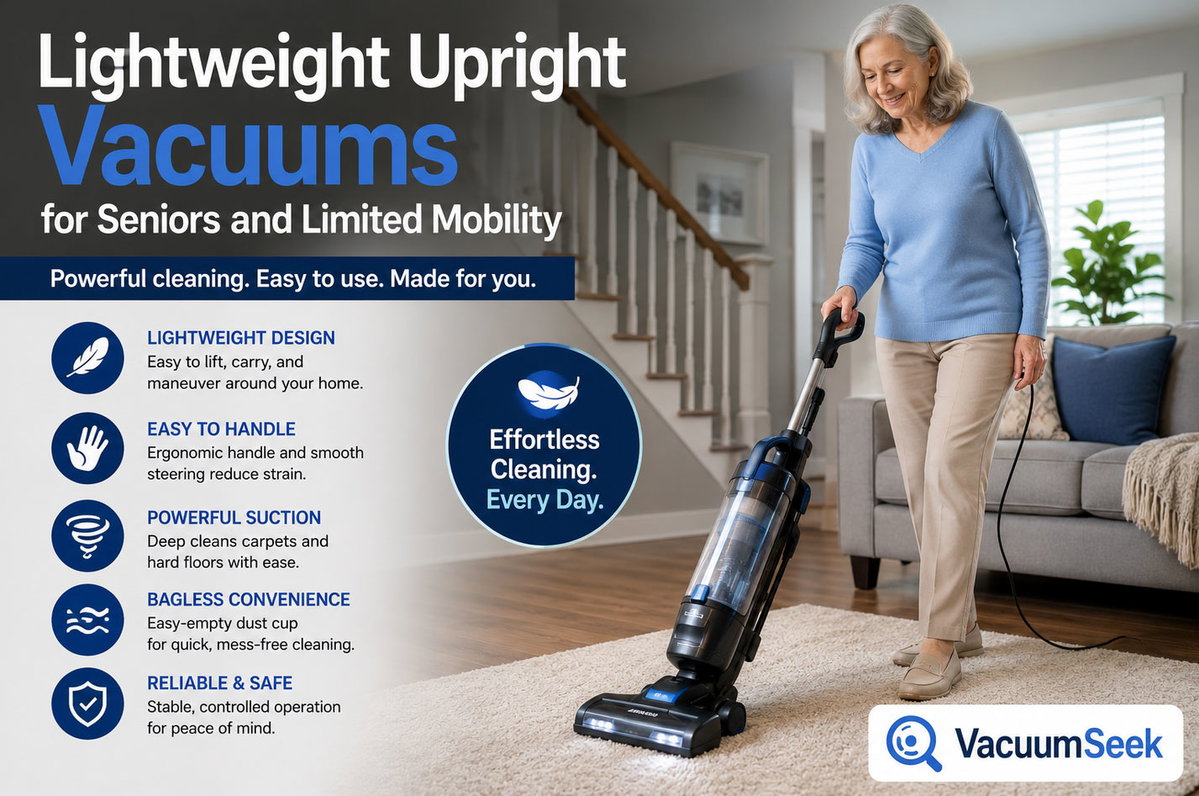
There's a particular kind of quiet defeat that comes from standing in your own living room, staring at a vacuum cleaner that feels like it weighs as much as a golden retriever. For millions of older adults and people living with arthritis, joint replacements, balance issues, or reduced upper-body strength, the humble household vacuum has quietly become one of the most physically demanding tools in the house. It's not glamorous. Nobody writes memoirs about it. But ask any occupational therapist, and they'll tell you that pushing, pulling, and lifting a heavy upright vacuum is one of the more common ways older adults strain a shoulder, tweak a lower back, or lose their footing on a rug edge.
This guide exists to fix that problem — not with vague reassurances, but with specifics. We'll walk through what actually makes a vacuum "senior-friendly," which lightweight upright models are worth your money right now, the safety habits that matter as much as the machine itself, and where to turn for support if cost or mobility challenges make shopping alone feel overwhelming.
Why Vacuum Weight Matters More Than Most People Realize
A standard full-size upright vacuum typically weighs somewhere between 15 and 22 pounds. That doesn't sound like much until you consider that vacuuming isn't a static lift — it's a repeated, dynamic motion involving pushing, pulling, twisting at the waist, and lifting the machine over thresholds, stairs, and furniture legs, often for twenty or thirty minutes at a stretch. For someone with osteoarthritis in the hands or wrists, rheumatoid arthritis in the shoulders, a healing hip, or simply the natural loss of grip strength and balance that comes with age, that repeated motion adds up fast.
The consequences aren't hypothetical. Overexertion and loss-of-balance incidents are consistently among the leading causes of home injury for adults over 65, and household chores involving reaching, bending, and pushing heavy equipment are frequently cited as contributing factors. A vacuum that's too heavy doesn't just make cleaning harder — it can make it genuinely unsafe, especially on stairs or slick flooring.
The good news is that vacuum design has changed dramatically over the past several years. Manufacturers have leaned hard into lightweight materials, self-propelled motors, and cordless battery technology, which means the trade-off that used to exist between "powerful" and "light" has mostly disappeared. You no longer have to choose between a vacuum that cleans well and one you can actually lift.
What "Lightweight" Really Means in Upright Vacuum Terms
Marketing copy throws the word "lightweight" around loosely, so it helps to have a working definition. In the upright vacuum category:
- Under 10 pounds is genuinely lightweight and manageable for almost anyone, including people with significant grip or shoulder limitations.
- 10 to 15 pounds is moderate — comfortable for most seniors, though it may be tiring during longer cleaning sessions or on stairs.
- 15 to 20 pounds is on the heavier end for this guide's purposes, though self-propelled motors can offset the weight considerably since the machine drives itself forward rather than requiring the user to push it.
- Over 20 pounds generally isn't recommended for someone managing arthritis, a recent surgery, or general frailty, regardless of how good the suction is.
Weight alone doesn't tell the whole story, though. A 17-pound self-propelled vacuum can feel easier to operate than a 9-pound manual one, because the effort of pushing — not just lifting — is often the bigger strain. That's why the next section matters as much as the number on the spec sheet.
The Features That Actually Matter for Seniors and Limited Mobility
Weight and Center of Gravity
Beyond the raw number, pay attention to where the weight sits. A vacuum with a heavy motor base and a light upper wand distributes weight low to the ground, which makes it more stable and easier to maneuver than a top-heavy design that tips or drags.
Self-Propelled Motors
Self-propelled uprights use a motorized brush roll to pull the vacuum forward, so the user is essentially just steering rather than pushing. This single feature can matter more than sheer weight for someone with shoulder or wrist arthritis, since it removes the repetitive forward-pushing motion that causes the most strain.
Cordless vs. Corded
Cordless stick-vacuum-style uprights eliminate the tripping hazard of a power cord snaking across the floor — a meaningful safety upgrade for anyone with balance concerns. The trade-off is battery life; many cordless models run 20 to 50 minutes per charge, which is plenty for most homes but worth checking against your square footage. The Levoit LVAC-200, for example, is frequently recommended as one of the lightest cordless options available, with a battery that lasts up to 50 minutes on a single charge and an anti-tangle brush roll that resists getting wrapped up in long hair. Corded models, meanwhile, never run out of power mid-clean, which matters for larger homes or thorough weekly deep cleans.
Bagged vs. Bagless
Bagless vacuums are convenient until the moment you have to empty the dust cup — a task that can require gripping a release latch, holding the canister at an angle over a trash can, and sometimes shaking loose debris free, all of which can be difficult with limited hand strength or if bending over a trash can is uncomfortable. Bagged vacuums avoid this entirely; you simply replace the bag every so often. The Oreck Commercial XL, for instance, uses traditional bags specifically so users don't have to deal with fussier bagless emptying mechanisms, and it automatically switches between carpet and hardwood settings without requiring the user to fiddle with levers or buttons.
Handle Height and Adjustability
An adjustable or telescoping handle lets the user stand fully upright while vacuuming rather than hunching forward, which reduces lower-back strain considerably. Some upright models, like the SEBO Premium Felix, are built with 180-degree steering and an adjustable handle height specifically to improve maneuverability, offering much of the flexibility of a canister vacuum in an upright body.
HEPA Filtration
For seniors managing asthma, COPD, or general respiratory sensitivity, a sealed HEPA filtration system prevents fine dust and allergens from being recirculated back into the air during cleaning — a detail that matters more with age as respiratory resilience naturally decreases.
Noise Level
Loud vacuums aren't just unpleasant; they can be disorienting for people with hearing aids or vestibular (balance) issues, since the noise can mask environmental cues that help maintain spatial awareness. Quieter motors are a genuine accessibility feature, not a luxury.
Freestanding Stability
A vacuum that can stand upright on its own without being propped against a wall is a small feature with outsized value — it means the user doesn't need to bend down repeatedly to pick it back up off the floor during pauses.
Strong Options Worth Considering Right Now
No single vacuum is right for every body, budget, or home, but a few models stand out consistently for combining low weight with genuine cleaning power.
For all-around ease of use, the Eureka PowerSpeed Lightweight Upright is frequently rated as a best-overall pick for seniors, prized for its light frame and strong suction that together make it easy to maneuver, while the Eureka RapidClean Pro offers a cordless alternative with quick setup, though its battery runtime is more limited.
For cordless convenience with real suction power, Levoit markets its LVAC-200 and LVAC-300 models specifically around ergonomic, senior-friendly design, positioning them as a way to restore independence in daily cleaning routines without needing to rely on someone else for help.
For households with pets or allergy concerns, the Shark Navigator Lift-Away is often recommended for its HEPA filtration and pet-hair handling, though reviewers note its weight can be a drawback for some users, which is worth testing in person if possible. A newer alternative worth a look is the Shark Stratos line; the Shark AZ3002 Stratos DuoClean weighs about 17.2 pounds and uses a dual brush-roll system — one soft roller for hard floors and one stiffer roller for carpets — along with a lift-away feature that converts the upright into a canister-style unit for stairs and tight corners.
For a no-frills, traditional feel, the Oreck Commercial XL is a favorite among vacuum testers specifically for older adults, valued for being lightweight enough to carry up and down stairs, reliable across decades of brand history, and simple enough that there's little to go wrong mechanically.
For those wanting hybrid flexibility, the eufy 3-in-1 E20 combines a robot vacuum, a stick vacuum, and a handheld unit in a single system — at just 2.8 pounds in handheld mode, it's light enough to lift and guide without straining the wrist, while the robot mode handles routine floor cleaning independently.
Vacuums to Approach with Caution
Traditional canister vacuums — the kind many people grew up with — deserve a mention here mainly as a caution. Canister vacuums require dragging a separate unit behind you while maneuvering the hose, and while they're familiar to many older adults, they tend to be heavy and awkward to manage, particularly around corners and stairs. If a canister model is already in the home and working well, there's no urgent need to replace it — but if shoulder or wrist pain has started creeping in, it's usually the culprit worth investigating first.
Safety Considerations While Vacuuming
The best vacuum in the world doesn't eliminate the physical realities of cleaning a home. A few habits make a measurable difference in reducing fall and injury risk:
- Clear the path before you start. Loose rugs, phone chargers, and stray shoes are the most common tripping hazards during vacuuming, and they're easy to miss when attention is focused on the machine rather than the floor.
- Break the task into segments. Vacuuming the whole house in one session is unnecessary and tiring. Doing one or two rooms at a time, with rest breaks between, dramatically reduces overexertion risk.
- Push with the legs, not the back. Standing upright and using leg and core muscles to guide the vacuum — rather than bending at the waist — protects the lower back over repeated sessions.
- Store the vacuum somewhere accessible. A vacuum tucked in a high closet or a cramped basement corner creates an unnecessary lifting and reaching hazard before cleaning has even started. Keeping the vacuum and its charging dock in a central, easy-to-reach spot removes one more physical obstacle from the routine.
- Check the cord — or skip it entirely. If using a corded model, keep the cord gathered and visible rather than trailing loosely across walking paths.
If a fall or near-fall has happened during routine chores like vacuuming, it's worth mentioning to a doctor or physical therapist, since it can be an early signal of balance changes worth addressing directly.
When a Robot Vacuum Might Be the Better Answer
For some households, the honest answer isn't a lighter upright — it's skipping the pushing motion altogether. Robot vacuums have matured considerably and now offer real advantages for people who struggle with any manual vacuuming, regardless of how light the machine is. Scheduled robot vacuums clean consistently without requiring the user to be physically available, and models with auto-emptying stations can go weeks between manual dust-bin maintenance, which meaningfully reduces the bending and lifting that robot vacuums would otherwise still require.
The trade-off is that robot vacuums generally can't handle stairs, and they still need occasional maintenance — brush cleaning, filter changes, and troubleshooting when they get stuck under furniture. A common and quite sensible solution is pairing a robot vacuum for daily floor maintenance with a lightweight cordless handheld for stairs, upholstery, and spot cleaning, which covers the gaps without requiring a full-size upright at all.
How Family Members and Caregivers Can Help
If you're helping a parent, spouse, or older relative choose a vacuum, resist the instinct to buy the "best" one online without them in the room. Grip comfort, handle height, and how a vacuum feels when pushed across their specific flooring matter far more than star ratings. Where possible, test the vacuum in the store or choose a retailer with an easy return policy, since a vacuum that looks light on paper can still feel unwieldy for a particular person's hands and shoulders.
It's also worth having a low-pressure conversation about whether vacuuming should remain a solo task at all. Many families split cleaning duties — a family member or a home-care aide handling the heavier weekly deep clean, while the older adult manages daily light touch-ups with a lightweight cordless unit. This isn't about taking away independence; it's about protecting it by preventing an injury that would take independence away far more abruptly.
Financial Assistance and Where to Find Support
Cost can be a real barrier, especially for lightweight cordless models, which tend to run higher than basic corded uprights. A few organizations offer resources, benefits screening, or general guidance that can help offset the cost or point toward accessible-living support more broadly:
Arthritis Foundation 1355 Peachtree Street NE, Suite 600, Atlanta, GA 30309 — Helpline: (800) 283-7800 Website: arthritis.org Offers practical living guides and product recommendations specifically for people managing joint pain during everyday tasks like cleaning.
AARP 601 E Street NW, Washington, DC 20049 — Phone: 1-888-687-2277 Website: aarp.org Publishes regular home-product testing and reviews aimed at older adults, along with broader resources on aging in place safely.
National Council on Aging (NCOA) 251 18th Street South, Suite 500, Arlington, VA 22202 — Phone: (571) 527-3900 Website: ncoa.org Runs BenefitsCheckUp, a free tool that screens for financial assistance programs older adults may qualify for, which can sometimes free up budget for home equipment.
American Occupational Therapy Association (AOTA) 6116 Executive Blvd, Suite 200, North Bethesda, MD 20852 — Phone: 1-800-729-2682 Website: aota.org A good starting point for finding a local occupational therapist who can evaluate home tasks — including cleaning — and recommend adaptive tools or techniques suited to a specific condition.
U.S. Consumer Product Safety Commission (CPSC) 4330 East West Highway, Bethesda, MD 20814 — Consumer Hotline: 800-638-2772 Website: cpsc.gov Worth checking before any major appliance purchase — the CPSC maintains an up-to-date public database of product recalls, including vacuum cleaner safety notices.
Frequently Asked Questions
What is the lightest upright vacuum a senior with arthritis can comfortably use? Generally, anything under 10 pounds is considered highly manageable, though a self-propelled or cordless stick-style upright in the 10–15 pound range can feel just as easy in practice, since the motor — not the user's arms — does most of the pushing.
Is a cordless or corded vacuum better for someone with limited mobility? Cordless is usually preferable for safety, since it removes the tripping hazard of a trailing cord, though battery runtime should be checked against home size. Corded models remain a solid choice for larger homes or longer deep-cleaning sessions.
Are robot vacuums a good substitute for uprights for elderly users? For daily floor maintenance, yes — especially models with auto-emptying stations. Most households still keep a lightweight handheld or stick vacuum on hand for stairs and upholstery, since robot vacuums can't manage those areas.
What vacuum feature matters most for people with arthritis in the hands? A self-propelled motor and an anti-tangle brush roll tend to matter more than raw weight, since they reduce the repetitive gripping and pushing motion that aggravates joint pain.
Where can I find financial help for buying adaptive home equipment as a senior? The National Council on Aging's BenefitsCheckUp tool, available through ncoa.org, screens for assistance programs based on income and location, and is a reasonable first stop before assuming a purchase is out of reach.
Final Thoughts
A vacuum cleaner shouldn't be the reason someone dreads a Tuesday afternoon or puts off cleaning until it becomes overwhelming. The technology has genuinely caught up to the need — self-propelled motors, sub-10-pound frames, and cordless designs mean nobody has to choose between a clean floor and a sore shoulder anymore. The right choice isn't necessarily the most expensive or most reviewed model; it's the one that fits a specific person's grip strength, home layout, and daily energy level. Testing a few options in person, involving an occupational therapist if joint pain is a serious factor, and leaning on the resources above when cost feels like a barrier will get most people to a vacuum that makes cleaning feel like a task again — not an ordeal.