
Pool Vacuum Maintenance Checklist for Off-Season Storage
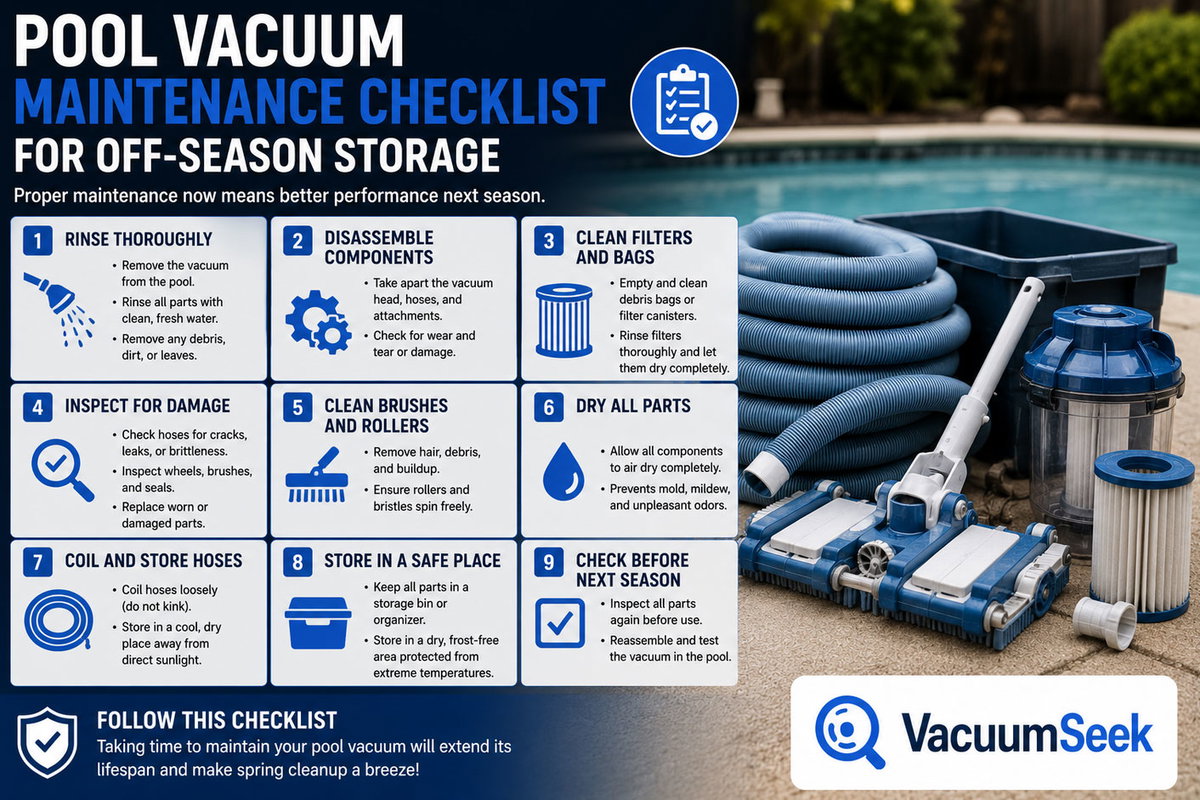
Every fall, somewhere between the last cannonball and the first frost warning, a pool vacuum gets shoved into a garage corner still damp, still full of last week's leaves, and forgotten until Memorial Day. Then it doesn't turn on. Or it turns on and drags itself sideways in circles like it's had a stroke. Or the brushes have hardened into something closer to concrete than rubber.
None of that is bad luck. It's the predictable result of skipping a handful of steps that take less time than a single pool cleaning cycle. A vacuum — robotic, suction-side, or pressure-side — is a small machine full of motors, seals, impellers, and electronics that were never designed to sit wet and idle for four to six months. Off-season storage isn't an afterthought tacked onto winterizing the pool itself; it's its own discipline, with its own checklist, and it deserves to be treated that way.
This guide walks through that discipline start to finish: what to clean, what to check, what to disconnect, where to store the unit, and how to bring it back to life in spring without any surprises. It's written for anyone shutting down a residential pool for winter, whether the "off-season" lasts eight weeks in Florida or eight months in Minnesota.
Why Off-Season Storage Care Actually Matters
A pool vacuum is, mechanically speaking, a small appliance that lives underwater. That's an unusual design brief, and manufacturers solve it with seals, gaskets, and drainage systems that assume the unit will be actively used and periodically dried out — not left wet and sealed shut for a season.
Three things go wrong when a vacuum is stored carelessly:
Trapped moisture becomes a chemistry lab. Pool water left inside a filter canister or float chamber doesn't just sit there — it evaporates slowly, leaving behind concentrated mineral deposits and, if any organic debris was trapped with it, mold. By spring, what should have been a five-minute rinse turns into a scrub-and-soak job, or in bad cases, a corroded internal component.
Rubber and plastic degrade under stress. Tracks, brushes, wheels, and seals are made from materials that harden and crack when left compressed, dry, or exposed to temperature swings. A vacuum stored with its brushes pressed against a garage floor for six months often comes out with flat spots that never fully round out again.
Batteries and electronics don't like being ignored. Robotic pool cleaners with lithium-ion battery packs (common in cordless models) lose charge slowly even when off. Left fully depleted for months, many battery chemistries suffer permanent capacity loss. Corded models aren't immune either — power supply units and control boards dislike sitting in unheated, humid sheds.
None of this is exotic knowledge. It's the same logic that applies to storing a lawnmower, a generator, or a boat engine: machines that interact with water and electricity need a deliberate shutdown procedure, not just an "off" switch.
Know Your Vacuum Type Before You Start
Storage prep isn't identical across every pool cleaner on the market. The three major categories — robotic, suction-side, and pressure-side — have different vulnerabilities, and a checklist written for one can actually damage another if followed blindly.
Robotic Pool Cleaners
Robotic cleaners (think Dolphin, Polaris robotic models, or similar self-contained units) run their own internal pump and motor, plug into a low-voltage power supply, and typically use a filter cartridge or basket rather than relying on the pool's plumbing. Because they're self-contained, they're also the most electronics-heavy, which makes moisture, corrosion, and battery management the top storage priorities.
Suction-Side Cleaners
These attach to the pool's skimmer or a dedicated suction line and rely on the pool pump to create the vacuum action. They have fewer electronics but more hosing — long, segmented tubing that kinks, cracks, or develops mildew if coiled wrong and stored wet.
Pressure-Side Cleaners
These connect to a dedicated pressure line (or use a booster pump) and rely on water pressure to move and often to power an internal turbine that agitates debris into a bag. Their storage risk centers on the collection bag, the turbine, and — if it's a booster-pump-fed model — the booster pump itself, which needs its own winterization separate from the cleaner.
Knowing which category applies determines which items on the checklist below matter most for a given unit.
The Pre-Storage Deep Clean Checklist
Before anything goes into a box, bag, or shelf, it needs a real cleaning — not just a rinse. This is the step most people shortcut, and it's the one that causes the most spring-time headaches.
- Empty and rinse the filter, basket, or bag completely. Debris left inside decomposes over winter and can stain or corrode the housing.
- Remove and individually rinse brushes, wheels, or tracks. Use plain water; avoid harsh solvents that can dry out rubber compounds.
- Wipe down the housing with a soft cloth and, if there's visible scale or calcium buildup, a diluted vinegar solution rather than an abrasive pad.
- Inspect and clean the impeller area (robotic and pressure-side units) for hair, string, or small debris that can jam the motor on first use next season.
- Check all seals and gaskets for cracking, warping, or brittleness. A seal that looks marginal in fall will almost certainly fail in spring.
- Fully dry the unit before sealing it in any storage container — a fan or a few hours in open air is enough; never use a hair dryer or heat gun directly on plastic components.
- Disconnect and coil hoses loosely, never in tight loops, to prevent permanent kinking or stress cracks.
- Remove batteries from remote controls or handheld units, since alkaline batteries left in devices over winter are a classic source of corrosion damage.
This deep clean typically takes twenty to forty minutes depending on the vacuum type, and it's the single highest-leverage step in the entire process.
Comparison Table: Off-Season Storage Requirements by Vacuum Type
| Storage Factor | Robotic Cleaner | Suction-Side Cleaner | Pressure-Side Cleaner |
|---|---|---|---|
| Primary storage risk | Battery drain, electronics corrosion | Hose cracking, moisture in swivel joints | Turbine jamming, bag mildew |
| Power disconnection | Unplug power supply; store indoors away from humidity | Not applicable (no independent power) | Disconnect booster pump if used |
| Battery care | Charge to ~50% before storage; recharge every 6–8 weeks | N/A | N/A (unless remote-controlled model) |
| Filter/bag cleaning | Remove and hand-wash cartridge or basket | Empty and rinse skimmer basket/leaf bag | Empty, rinse, and air-dry collection bag |
| Hose handling | N/A (self-contained) | Coil loosely, hang or lay flat, avoid kinks | Coil loosely; check for pinholes before storage |
| Ideal storage temperature | Above freezing, climate-controlled if possible | Above freezing preferred, garage acceptable | Above freezing preferred, garage acceptable |
| Recommended check-in frequency | Every 4–6 weeks (battery + moisture check) | Once mid-season (hose position check) | Once mid-season (bag and turbine check) |
| Typical off-season prep time | 30–40 minutes | 15–20 minutes | 20–30 minutes |
The pattern worth noticing: robotic cleaners demand the most ongoing attention because they're the only category with a battery and onboard electronics that actively degrade from neglect, not just from moisture.
Step-by-Step Winterization Checklist
Once the deep clean is done, storage prep follows a sequence. Treat this as the master checklist, adapting individual steps to the vacuum type using the table above.
- Confirm the pool itself is fully winterized first. Chemical levels, water level, and cover placement should be settled before the vacuum comes out of the water for the last time — pulling it early or late can mean missing a final cleaning pass the pool actually needed.
- Run one final short cycle in clean water, if possible, to flush the internals with fresh water rather than pool chemicals, especially for robotic units with internal pump chambers.
- Disconnect all power sources. Unplug transformers and power supplies completely rather than leaving them plugged into a switched-off outlet; standby draw and humidity exposure both matter.
- Complete the deep clean checklist outlined above.
- Inspect the power cord (robotic units) for nicks, cracks, or exposed wire, particularly near the connection points, which take the most flexing stress over a season of use.
- Label and bag small parts — screws, brush caps, connector pins — in a clearly marked container so nothing gets lost between now and spring.
- Choose a storage location that's dry, temperature-stable, and out of direct sunlight (UV exposure degrades plastics and rubber even indoors near a window).
- Store the unit off the ground on a shelf or pallet rather than directly on a concrete floor, which can sweat with humidity changes and transfer moisture upward.
- Set a reminder for mid-season battery maintenance if the unit is cordless — most manufacturers recommend a partial recharge every four to eight weeks rather than leaving a battery fully depleted for the entire off-season.
- Photograph the setup (hose routing, cable management, accessory placement) before final storage — a thirty-second photo saves real frustration when reassembling in spring.
Common Mistakes That Kill Vacuums Over Winter
Most storage-related failures trace back to a small number of repeat offenders, and it's worth naming them plainly.
Storing it wet. This is the single most common mistake, and it's responsible for the majority of mold, mildew, and corrosion damage reported by pool owners each spring. Even a small amount of trapped water in a filter housing can cause problems over a long winter.
Leaving batteries fully drained. A lithium-ion battery left at zero percent for months is far more likely to suffer permanent capacity loss than one stored at a partial charge. This is standard battery chemistry, not a quirk specific to pool equipment.
Coiling hoses too tightly. Vinyl and rubber hosing develops "memory" over time. Hoses stored in a tight coil for months often refuse to lie flat again, which affects performance and can create pressure points that eventually crack.
Storing near temperature extremes. An attic that hits 130°F in summer sun or an unheated shed that drops well below freezing both stress plastic components and seals in ways that shorten a vacuum's working life. A moderate, stable environment — a basement, insulated garage, or climate-controlled storage room — is worth prioritizing over pure convenience.
Skipping the mid-season check. Off-season storage isn't "set it and forget it" for four to six months, especially for battery-powered units. A single fifteen-minute check partway through the off-season catches problems — a slow leak, a swelling battery, an unexpected pest issue — before they become expensive.
Using the wrong cleaning products. Bleach, ammonia-based cleaners, and abrasive pads can degrade rubber seals and cloud clear plastic housings. Mild soap and water, or a diluted vinegar rinse for scale, is sufficient for nearly all residential units.
Where to Store It: Climate, Humidity, and Location Considerations
Location matters as much as preparation. The ideal off-season storage spot shares four characteristics: stable temperature, low humidity, no direct sunlight, and easy accessibility for that mid-season check.
A finished basement or a climate-controlled utility room is close to ideal. An attached garage is a reasonable middle ground, particularly in regions where winter temperatures don't swing dramatically below freezing. Detached sheds and unheated outbuildings are the riskiest common choice — they expose equipment to the widest temperature swings and the highest humidity variation, especially in regions with real winters.
For pool owners in genuinely cold climates — the Upper Midwest, the Northeast, and similar zones — bringing electronics-heavy robotic cleaners indoors isn't excessive caution; it's standard practice among pool service professionals. Suction-side and pressure-side units, having fewer electronics, tolerate garage storage more comfortably, provided hoses are protected from being crushed under other stored items.
Spring Reactivation: Bringing the Vacuum Back to Life
The spring side of this checklist is shorter, but skipping it is exactly how "it worked fine last fall" turns into a service call.
- Inspect before powering on. Look over seals, brushes, and cords for any winter damage before the unit ever touches water.
- Fully charge cordless batteries before first use rather than assuming a partial charge will hold up through a first cleaning cycle.
- Reinstall filters, bags, or baskets and confirm they seat correctly — a housing that sat empty for months can develop a slightly different fit as gaskets settle.
- Run a short test cycle in shallow water or a bucket before the first full pool cleaning, to confirm the motor, tracks, or turbine are moving correctly.
- Check hose connections on suction- and pressure-side units for any looseness or cracking that appeared over winter.
- Update firmware, if applicable — many modern robotic cleaners with app connectivity release software updates over the winter months that are worth installing before the first swim season use.
Manufacturer Resources and Support Contacts
For warranty questions, replacement parts, or manufacturer-specific storage guidance, these are useful starting points. Always check the specific model's manual first, since storage recommendations can vary by product line.
| Manufacturer | Known For | Website | Corporate Address |
|---|---|---|---|
| Hayward Holdings | Pumps, filters, suction- and pressure-side cleaners | hayward.com | 1415 Vantage Park Drive, Suite 400, Charlotte, NC 28203 |
| Pentair (Pool Division) | Pumps, cleaners, automation systems | pentair.com | 1701 Pinnacle Center Drive, Apex, NC 27539 |
| Maytronics US (Dolphin) | Robotic pool cleaners | maytronicsus.com | 2221 Northmont Pkwy, Suite 400, Duluth, GA 30096 |
| Pool & Hot Tub Alliance (PHTA) | Industry standards, education, safety guidance | phta.org | 1650 King St., Suite 602, Alexandria, VA 22314 |
The PHTA in particular is worth bookmarking beyond this checklist — as the accredited standards body for the pool and spa industry, its published guidance covers everything from water chemistry to equipment safety, independent of any single brand's marketing.
Frequently Asked Questions
How often should I check on a stored pool vacuum during winter? Roughly every four to six weeks for robotic and battery-powered units, mainly to maintain a partial battery charge. Suction- and pressure-side units without batteries can generally go a full season with just one mid-point inspection.
Can I store a pool vacuum in an unheated garage? Yes, for most suction-side and pressure-side cleaners in moderate climates. Robotic cleaners with onboard electronics and batteries fare better in a climate-controlled space, especially where winter temperatures regularly drop below freezing.
Should a robotic pool cleaner's battery be fully charged or fully drained for storage? Neither extreme is ideal. A partial charge, generally in the 40–60% range, and a recharge every four to eight weeks is the approach most manufacturers recommend for lithium-ion battery packs.
Is it necessary to remove the filter cartridge before storing the unit? Yes. Filters and baskets left in place trap moisture and debris, which leads to mold and mineral buildup that's far harder to clean out after months of sitting than it would have been the day it came out of the pool.
What's the biggest cause of pool vacuum failure after off-season storage? Storing the unit wet is the most frequent culprit, followed closely by battery neglect in cordless models. Both are entirely preventable with the checklist above.
The Bottom Line
A pool vacuum that gets a proper send-off in the fall is a pool vacuum that starts on the first try come spring. None of the steps here require special tools or technical expertise — just a deliberate half hour of cleaning, drying, and thoughtful placement, plus one or two check-ins during the months in between. Compared to the cost of a replacement motor, a new battery pack, or an entirely new unit, that half hour is one of the better returns on effort available to any pool owner heading into the off-season.