
Robot Vacuum and Mop Combos: Are They Worth It?
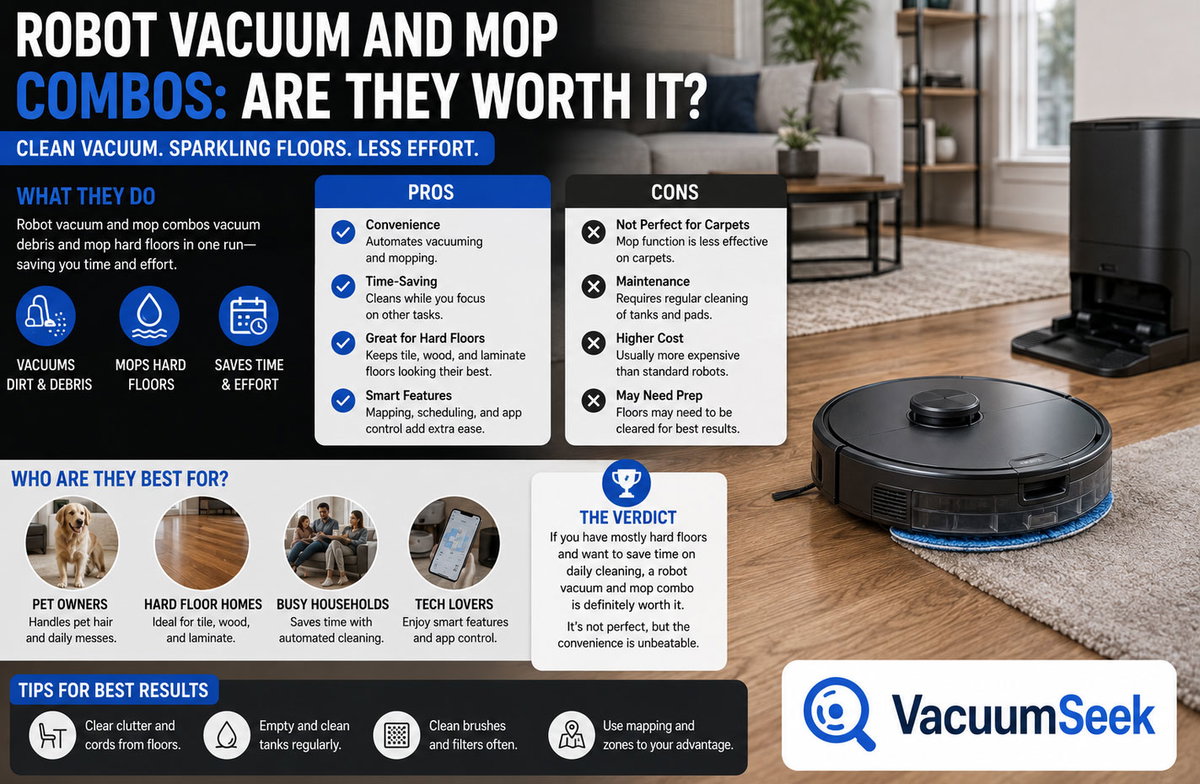
A decade ago, robot vacuums were a novelty gift you regifted after three collisions with a phone charger. Robot mops barely existed outside of trade show demos. Today, the two have merged into a single appliance that promises to vacuum your hardwood, scrub last night's spaghetti sauce off the kitchen tile, empty its own dustbin, wash its own mop pads, and dry itself before its next shift — all while you're at work, asleep, or simply doing literally anything else.
That's a big promise for a machine that usually costs somewhere between $300 and $1,800. So the question worth asking isn't whether robot vacuum-mop combos exist (they clearly do, in overwhelming numbers) but whether they actually deliver enough value to justify the price, the counter space their dock eats up, and the learning curve of a new gadget in your home. Let's break it down honestly, section by section.
What a "Combo" Actually Means
"Robot vacuum-mop combo" gets used loosely, so it's worth pinning down. There are really three categories on the market:
True 2-in-1 robots carry both a vacuum system and a mop pad or roller on the same chassis, cleaning in a single pass. This is what most people picture when they hear "combo," and it's the fastest-growing segment.
Vacuum-first hybrids are primarily vacuums with a basic mop attachment bolted on — usually a water tank and a microfiber pad that drags behind the robot. These tend to be budget-friendly but mop shallowly, more of a light polish than a scrub.
All-in-one docking systems pair a genuinely capable 2-in-1 robot with a base station that self-empties the dustbin, refills and drains the mop's water tank, washes the mop pads with hot water, and dries them with warm air to prevent mildew smell. This is the category driving most of the excitement — and most of the price tag — in 2026.
Understanding which category a listing falls into matters more than almost any other spec, because the gap in real-world performance between a $250 drag-mop hybrid and a $1,200 self-washing docking system is enormous.
The Mechanics: How One Machine Cleans Two Ways
Vacuuming and mopping are mechanically opposed tasks. One wants a dry, suction-driven system; the other wants a wet, friction-driven one. Engineering both into a single robot without one interfering with the other is the whole challenge, and manufacturers have converged on a few solutions.
Most combos use a retractable or liftable mop pad that raises itself off the floor by a few millimeters when the robot detects carpet, so it doesn't drag a soggy pad across your rug. Higher-end models use spinning mop pads — usually two counter-rotating discs — that scrub with actual mechanical pressure rather than just gliding, similar to how a buffer works on hardwood floors. A newer design uses a rolling mop, essentially a slim, wet rotating drum that continuously self-cleans against a scraper as it works, which tends to leave less dirty water smeared around than pad-based systems.
On the vacuuming side, most of these robots still rely on a rubber or bristle roller brush paired with a side brush to sweep debris toward the suction inlet, with LiDAR or camera-based mapping to plan efficient, room-by-room routes instead of the old random bump-and-turn pattern. The suction and mopping systems typically run sequentially within a pass rather than truly simultaneously in a physical sense, but from a user's perspective, it happens in one trip around the house.
The Strongest Argument For Buying One
The single biggest thing a combo unit buys you is the elimination of a two-step chore. Traditionally, keeping floors properly clean meant vacuuming first to lift loose debris, then mopping separately to handle grime and stains — two separate sessions, two separate tools, two separate blocks of your time. A combo folds that into one automated routine that can run on a schedule while you're not even home.
For households with pets, that automation compounds. Fur and dander accumulate daily, and a robot that vacuums the living room floor every afternoon prevents the kind of buildup that turns into a weekend-long deep clean. For people with mobility limitations, back problems, or simply packed schedules, a machine that handles both dry debris and sticky floor grime without being pushed around by hand is a genuine quality-of-life upgrade, not just a gadget flex.
The top-tier docking systems push this further. A robot that empties its own bin, refills its own mop water, and washes and air-dries its own pads can realistically run unattended for weeks. That's the closest the category has come to true "set it and forget it" home maintenance, and for the right household, it changes the day-to-day feel of a home more than almost any other single purchase in this price range.
Where the Hype Runs Into Reality
None of that means these machines are magic, and the marketing tends to outrun the experience in a few predictable places.
Mopping is still shallow cleaning. Even the best robot mops apply far less pressure and use far less water than a human with a string mop and a bucket. They're excellent at maintaining floors — keeping dust, light spills, and everyday grime from building up — but they generally aren't a substitute for an occasional real deep clean, especially on sticky or caked-on messes.
Carpets and mopping don't mix well. Manufacturers have gotten better at pad-lifting technology, but homes with a lot of low-pile carpet bordering hard flooring sometimes see damp edges or the robot avoiding transitions altogether. If your home is mostly carpet, a combo unit's mopping half may go almost unused.
Maintenance doesn't disappear — it changes shape. Even self-washing docks need their clean-water tank refilled, their dirty-water tank emptied, and their filters and mop pads replaced periodically. It's less frequent than manual mopping, but it's not zero. Ignore it for too long and you get a machine that smells like a gym bag.
Obstacle handling is improved, not perfect. Loose cables, pet accidents, and small toys can still trip up navigation systems, even with camera-based object recognition. Most complaints about combos in owner reviews trace back to obstacle mishandling rather than the cleaning performance itself.
They're loud during self-cleaning cycles. The dock's washing and drying process is often noisier than the robot's actual cleaning run, which matters if the dock lives near a bedroom or a home office.
Docking Stations: The Real Innovation
If there's one development that actually justifies the premium pricing in this category, it's the docking station, not the robot itself. A base that automatically empties dust into a disposable bag, refills and dumps mop water, scrubs the pads with heated water, and blows them dry is doing the genuinely unpleasant parts of the job that used to fall on a human. That's the difference between "a vacuum that also sort of mops" and "a floor-care system you interact with once every few weeks."
The tradeoff is size and price. These stations are bulky — some are close to the size of a small trash can — and they need a reasonably open spot near an outlet, ideally on a hard floor rather than carpet or a rug. They also represent most of the cost jump between a $350 vacuum-mop hybrid and a $1,000-plus all-in-one system. Whether that jump is worth it depends heavily on how much you value never touching a dirty mop pad again.
Combo vs. Separate Machines: A Side-by-Side Look
It's tempting to assume a combo always beats owning a separate robot vacuum and a separate robot mop, but that's not universally true.
A dedicated robot mop paired with a dedicated robot vacuum can each be optimized for its single job — often meaning stronger suction on the vacuum side and more aggressive scrubbing on the mop side, since neither has to compromise its design to accommodate the other function. Running them separately also means you can vacuum daily and mop twice a week, rather than mopping every single time whether the floor needs it or not, which saves water, pads, and wear.
The combo's advantage is convenience and often footprint: one dock instead of two, one app instead of two, and one purchase instead of two separate ones (which, notably, can sometimes cost more combined than a single well-specced hybrid). For most households, especially renters or people in apartments, the single-machine, single-dock simplicity of a combo outweighs the marginal performance gains of running separate specialized robots.
Who Actually Benefits From a Combo
This category makes the most sense for:
- Households with mostly hard flooring (tile, hardwood, vinyl, laminate) where mopping actually gets used regularly.
- Pet owners dealing with daily fur, dander, and the occasional muddy paw print.
- Busy professionals or parents who want floor care to happen automatically rather than as another item on a to-do list.
- People with back, knee, or mobility issues for whom manual mopping is physically taxing.
- Anyone replacing an aging, separate robot vacuum who wants to consolidate two appliances into one dock and one app.
Who Should Probably Skip It
- Homes that are 80%+ carpet, where the mopping function will mostly sit idle.
- Anyone expecting deep-clean, scrub-the-grout-lines performance — that's still a job for a mop and knees, or a wet/dry upright.
- Budget-conscious buyers who'd rather put $300 toward a great dedicated vacuum than $300 toward a mediocre combo that does both jobs adequately.
- Households with a lot of loose cords, pet toys, or clutter on the floor, where navigation struggles will cause more frustration than convenience.
Shopping Checklist: What Actually Matters
Specs sheets for these machines are dense with jargon, but a handful of features separate the genuinely useful models from the gimmicky ones:
- Navigation type. LiDAR-based mapping is generally more reliable than camera-only or bump-sensor navigation, especially in low light.
- Mop lift height and detection. Look for automatic pad lifting on carpet — this alone prevents most of the "wet carpet" complaints.
- Auto-empty and auto-wash dock. If budget allows, this is the single upgrade that most changes the day-to-day experience.
- Suction power and roller design. Pet owners especially should look for tangle-resistant brush designs, since traditional bristle brushes trap hair badly.
- App control and mapping persistence. Multi-floor mapping, no-go zones, and room-specific scheduling matter more in daily use than most people expect before owning one.
- Water tank and mop pad replacement cost. Some ecosystems lock you into proprietary pads or cleaning solution; factor that ongoing cost in before buying.
Meet the Companies Behind the Machines
Because this is a genuinely crowded category, it helps to know who's actually making these things — useful both for research and if you ever need to reach a company directly for warranty or support matters. Here are the corporate addresses of some of the best-known names in the space:
- iRobot (Roomba and Braava lines) — headquartered at 8 Crosby Drive, Bedford, MA 01730.
- SharkNinja (Shark brand) — corporate headquarters located at 89 A St, Needham, Massachusetts 02494.
- Roborock — global headquarters at Kangjian Baosheng Plaza, No. 8 Heiquan Road, Haidian District, Beijing, China.
- Ecovacs (Deebot line) — headquartered in Suzhou, China, with its U.S. arm, Ecovacs Robotics Americas, based in San Mateo, California.
- eufy (Anker's home brand) — U.S. operations run through Power Mobile Life, LLC, at 400 108th Ave NE, Suite 400, Bellevue, WA 98004.
Keep in mind that Roborock, Ecovacs, and eufy design and manufacture primarily in China, then sell through regional subsidiaries and third-party retailers in North America and Europe — which is why warranty terms, customer support quality, and firmware update cadence can vary noticeably even between models that look nearly identical on a spec sheet.
The True Cost of Ownership
The sticker price is only the entry fee. Ongoing costs to factor in before buying include replacement mop pads (often $15–$40 for a multi-pack), dustbin bags for auto-empty docks, filter replacements every few months, occasional roller brush replacements, and — for higher-end units — proprietary cleaning solution if the manufacturer locks that in. Over two to three years of ownership, these consumables can add up to a meaningful fraction of the machine's original price, so it's worth checking replacement part costs during research rather than after the purchase.
Electricity use is negligible; these units draw very little power both while charging and while running self-cleaning cycles. Water usage for the mop function is also modest, though it does add a small amount to a household's water bill if used daily.
Where Serious Reviewers Actually Test These Things
Because so much of the online chatter around robot vacuum-mops comes from affiliate-driven listicles recycling manufacturer marketing copy, it's worth leaning on outlets that run controlled, side-by-side testing rather than repackaging spec sheets. A few worth bookmarking:
- RTINGS runs standardized lab tests across suction, mopping stain removal, and navigation for dozens of models.
- Consumer Reports tests combo units on both wet and dry pickup performance and ease of use.
- CNN Underscored publishes hands-on, real-home testing with regular updates as new models launch.
- TechRadar covers new releases as they're announced, useful for tracking upcoming models before they hit retail.
- The Smart Home Hookup runs detailed, repeatable at-home comparison tests including carpet pickup and mopping stain-removal trials across competing brands.
Cross-referencing two or three of these before buying will tell you far more than any single "Top 10" roundup.
Frequently Asked Questions
Are robot vacuum-mop combos actually worth the money? For households with substantial hard flooring, pets, or limited time for manual cleaning, yes — the convenience of automated daily maintenance genuinely reduces manual chore time. For mostly-carpeted homes or people expecting deep-clean results, a dedicated vacuum plus occasional manual mopping may deliver better value.
Do robot mops damage hardwood floors? Properly functioning units with pad-lifting and moisture-control features are generally safe on sealed hardwood. Problems tend to arise from unsealed or damaged wood, or from a malfunctioning water tank leaking excess moisture — both rare but worth checking your specific flooring's water tolerance before relying on daily mopping.
How often do I need to clean the robot itself? Even with a self-emptying, self-washing dock, expect to check and clean the roller brush weekly, replace mop pads every one to three months depending on use, and periodically wipe down sensors to maintain navigation accuracy.
Can these machines replace deep cleaning entirely? No. They're excellent for maintenance cleaning between deeper sessions, but heavily soiled floors, grout lines, and baseboards still benefit from occasional manual attention.
Is a $300 combo as good as a $1,000 one? Not typically. The price gap usually reflects real differences in navigation accuracy, suction power, mop mechanism sophistication, and — most significantly — whether the dock self-empties and self-washes. Budget models can still be a reasonable entry point for smaller homes with simpler layouts.
The Verdict
Robot vacuum-mop combos aren't a scam, and they aren't a miracle either — they're a genuinely useful appliance category that happens to be marketed with more enthusiasm than nuance. The honest takeaway is that they excel at maintenance cleaning: keeping floors consistently tidy between the deeper cleans that still require human effort. For hard-floor-heavy homes, pet owners, and anyone whose schedule leaves little room for chores, a well-chosen combo — especially one with a self-emptying, self-washing dock — earns its keep quickly. For carpet-dominant homes or anyone expecting deep-scrub results, the money may be better spent elsewhere, or split between a dedicated vacuum and the occasional manual mop session. The category has matured enough that "worth it" is no longer a gamble — it's simply a question of matching the machine to the floor plan you actually have.