
Steam Cleaners vs. Traditional Vacuums: Do You Need Both?
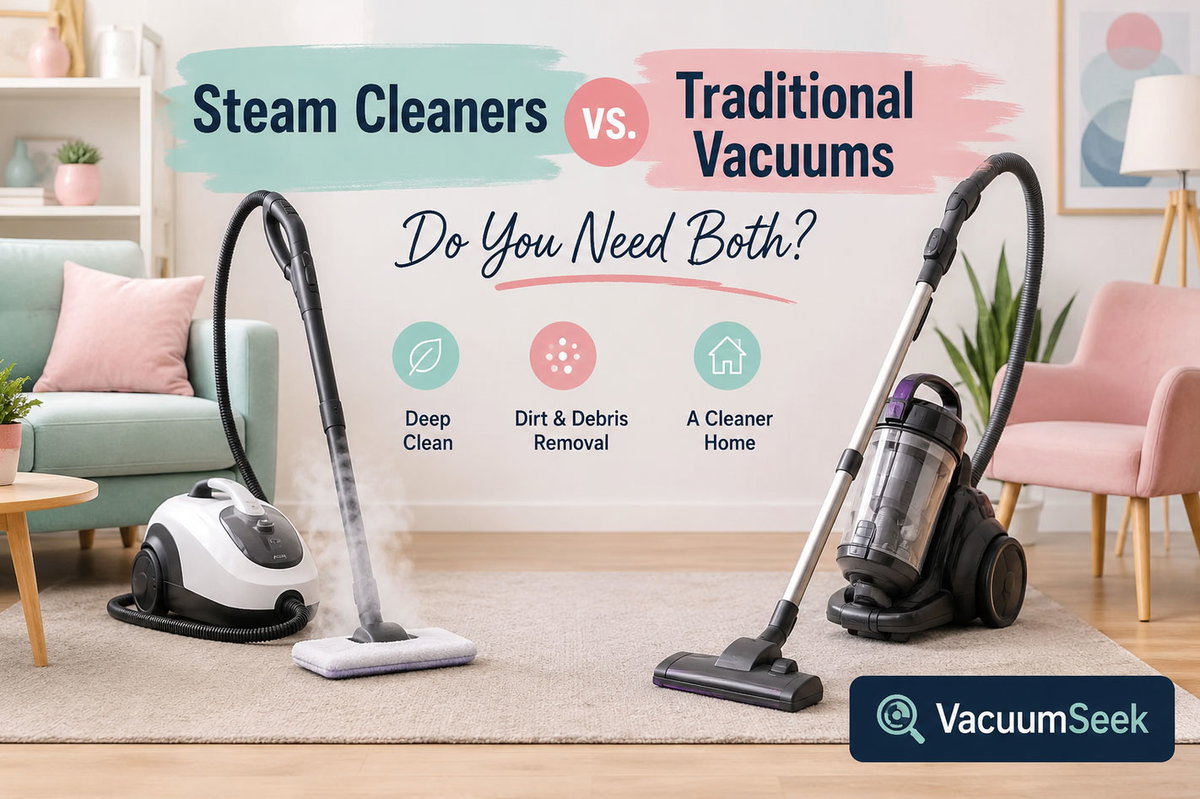
Somewhere between the vacuum aisle and the "as seen on TV" steam cleaner display, most people freeze. Both machines promise a cleaner home. Both come with confident marketing about allergens, germs, and floors that "sparkle like new." And both, if you ask the sales associate, are apparently the only appliance you'll ever need again.
That's not quite true, and it's also not quite false. Steam cleaners and traditional vacuums aren't competing products so much as they're colleagues with wildly different job descriptions. One moves air and traps particles. The other applies heat and moisture to kill and loosen what's stuck. Asking which one is "better" is a bit like asking whether a broom or a mop is better — the honest answer depends entirely on what's on the floor.
This piece breaks down exactly how each machine works, where they overlap, where they don't, and whether your household actually needs both or can get by with one well-chosen appliance.
The Short Answer
For most homes, yes — a traditional vacuum and a steam cleaner solve different problems, and owning both covers more ground than either does alone. A vacuum handles the daily grind: dust, crumbs, pet hair, and loose debris on carpets and floors. A steam cleaner handles the deeper, stickier, germier layer underneath: grease film on kitchen tile, grout lines, mattress hygiene, and sanitizing surfaces without chemicals. If you had to pick just one, your flooring type and household habits (pets, allergies, young kids, cooking frequency) should decide which one earns the spot in your closet first.
How a Traditional Vacuum Actually Works
A vacuum cleaner is, at its core, a controlled air-pressure trick. A motor spins an impeller that creates lower pressure inside the machine than in the room around it, and air rushes in to equalize that difference, dragging dust, hair, and debris along with it. That airflow passes through a filter — anything from a basic foam layer to a sealed HEPA system — before being pushed back out into the room.
Suction, Agitation, and Filtration
Three things determine how well a vacuum actually cleans: suction power, mechanical agitation (the spinning brush roll that lifts embedded dirt out of carpet fibers), and filtration quality. A machine can have enormous suction and still perform poorly on carpet if the brush roll isn't agitating the pile correctly, which is why lab-based buying guides test real debris like sand and cereal on actual carpet rather than relying on wattage numbers alone.
Filtration matters just as much as suction, especially for households managing allergies. According to the U.S. Environmental Protection Agency, a true HEPA filter is defined as removing at least 99.97% of particles as small as 0.3 microns, which covers most dust, pollen, and pet dander. A vacuum marketed as "HEPA-type" or "HEPA-like" isn't held to that same standard, so the wording on the box is worth reading closely before assuming allergy protection.
Where Vacuums Fall Short
Vacuums are excellent at removing loose, dry material. They are far less effective against anything bonded to a surface: baked-on grease on a stovetop, soap scum in grout, sticky spills on hard flooring, or bacteria living on a mattress. A vacuum can pull dust mite debris out of fabric, but it doesn't kill the mites themselves or sanitize what it touches — it's a removal tool, not a sanitizing one. That distinction is the entire reason steam cleaners exist as a separate category rather than a vacuum accessory.
How a Steam Cleaner Actually Works
A steam cleaner heats water in an internal boiler until it produces vapor, then forces that vapor out through a nozzle, brush head, or wand at high pressure. Depending on the model, output temperatures typically range from around 200°F to well over 300°F at the boiler, with surface-contact temperatures usually landing somewhere between 175°F and 250°F by the time steam reaches the material being cleaned.
Vapor, Heat, and Kill Temperatures
The heat is the whole point. Grease liquefies and lifts away instead of needing to be scrubbed off. Grout and tile release grime that's been ground in for months. And because steam reaches temperatures well past what most household bacteria, dust mites, and even bed bugs can survive, it functions as a chemical-free sanitizing method rather than just a cleaning one.
That last point has real backing. The EPA's guidance on do-it-yourself bed bug control specifically lists steam cleaners as an effective non-chemical tool, noting that steam applied at roughly 130°F or higher can kill bed bugs on contact when used correctly on mattresses, carpets, and upholstered furniture. That's a job no traditional vacuum, regardless of suction rating, is built to do.
Where Steam Falls Short
Steam cleaners are not designed to lift loose dirt or hair off a rug — moisture on top of debris can actually smear it into fibers instead of removing it. They also aren't a great fit for certain surfaces: unsealed hardwood, some laminate, and delicate upholstery can warp or discolor under sustained heat and moisture if you're not careful about dwell time and attachment choice. And a steam cleaner does nothing for airborne dust or pet hair sitting on a carpet's surface. It's a deep-clean and sanitizing tool, not a daily pickup tool.
Not All Vacuums (or Steam Cleaners) Are Built the Same
Part of what makes this comparison tricky is that "vacuum" and "steam cleaner" each describe a category, not a single product. The version of each machine that ends up in your closet matters almost as much as the category itself.
The Vacuum Family Tree
Upright vacuums put the motor directly over the brush roll, which gives them strong performance on carpet and wall-to-wall flooring, at the cost of a bulkier body that's harder to store. Canister vacuums separate the motor from the cleaning head, trading some carpet power for better maneuverability around furniture legs and stairs, and they tend to do especially well on bare floors and low-pile rugs. Stick and cordless vacuums prioritize weight and convenience over raw suction, which makes them a good fit for quick daily pickups but a weaker choice as a household's only vacuum if there's substantial carpet or pet hair to manage. Robotic vacuums handle maintenance-level upkeep between deeper cleans but generally can't match a full-sized machine's suction or edge performance. And handheld vacuums exist purely for spot jobs — car interiors, stairs, upholstery crumbs — rather than whole-room cleaning.
The Steam Cleaner Family Tree
Handheld steam cleaners are compact, low-capacity units best suited for spot-treating grout lines, stovetops, or small upholstery stains. Canister-style steam cleaners carry a larger water tank and higher, more sustained boiler pressure, making them the better choice for whole-floor jobs, mattress sanitizing, or bed bug treatment where dwell time and consistent heat matter. Steam mops are a hybrid of sorts — a flat pad head designed specifically for hard flooring, offering convenience for quick kitchen or bathroom floor cleaning without the broader attachment versatility of a full canister unit. Continuous-fill models, which allow you to top off water without waiting for the boiler to cool, tend to be worth the added cost for anyone planning to use steam regularly rather than occasionally.
Matching the right subtype to your actual living situation matters more than chasing the highest suction wattage or steam pressure number on the box. A powerful canister vacuum is wasted in a 500-square-foot apartment with no carpet, and a handheld steam unit won't have the sustained heat needed for serious bed bug treatment on a queen mattress.
Steam Cleaners vs. Traditional Vacuums: Side-by-Side Comparison
| Factor | Traditional Vacuum | Steam Cleaner |
|---|---|---|
| Primary mechanism | Suction + brush agitation | Heat + pressurized vapor |
| Best for | Loose dust, crumbs, pet hair, dry debris | Grease, grime, grout, bacteria, dust mites, bed bugs |
| Typical surfaces | Carpet, rugs, upholstery, hard floors | Tile, grout, sealed hard floors, mattresses, some upholstery |
| Sanitizes / kills germs | Rarely (only with true HEPA sealed systems for airborne particles) | Yes, at sufficient contact temperature |
| Chemical-free | Depends on filter, no cleaning solution needed | Fully chemical-free by design |
| Daily-use friendly | Yes — quick, low prep | Less so — requires water fill, heat-up time, cool-down |
| Risk to delicate surfaces | Low | Moderate (unsealed wood, some plastics, heat-sensitive fabrics) |
| Removes loose hair/crumbs | Excellent | Poor |
| Typical price range | $100–$700 | $60–$400 |
| Maintenance | Filter changes, bag/bin emptying, brush roll cleaning | Descaling, hose/nozzle checks, water refills |
| Noise level | Moderate to loud | Generally quieter |
What Each Machine Is Actually Built to Solve
Dust, Dander, and Loose Debris — Vacuum Territory
If your household deals with shedding pets, kids tracking things in from outside, or just the ordinary accumulation of dust that settles on carpet and hard floors every day, a vacuum is doing the heavy lifting no other appliance replaces. This is also where allergy management largely happens. Regular vacuuming with proper filtration is one of the most consistently recommended interventions for reducing indoor allergen exposure. Mayo Clinic's guidance on dust mite allergy specifically recommends vacuuming regularly with either a double-layered microfilter bag or a HEPA filter, noting that vacuuming alone won't eliminate mites but does meaningfully reduce surface dust and allergen load over time.
Grease, Grime, Bacteria, and Bed Bugs — Steam Territory
Steam earns its keep in the rooms where grease and grime accumulate — kitchens, bathrooms, grout lines — and in situations that call for sanitizing rather than just tidying: a mattress after an illness in the house, upholstery that's absorbed odors, or a secondhand piece of furniture you want to disinfect before it comes inside. It's also one of the few consumer-accessible, chemical-free tools with credible backing for bed bug treatment, which is a job most people would otherwise hand off entirely to a pest control service.
The Allergy and Air Quality Question
This is where the "do I need both" question gets genuinely practical rather than theoretical. Indoor allergens are a persistent, well-documented health issue. The CDC's guidance on controlling asthma lists dust mites and mold among the most common indoor triggers and recommends allergen-proof bedding covers alongside regular cleaning as core prevention steps. Neither a vacuum nor a steam cleaner alone fully addresses this picture:
- A vacuum with sealed HEPA filtration removes surface dust, pet dander, and some dust mite debris from carpets, rugs, and upholstery without recirculating it back into the air.
- A steam cleaner can raise mattress and upholstery surface temperatures high enough to kill dust mites directly, and to address bed bugs specifically, which a vacuum cannot do regardless of suction strength.
Households managing asthma or allergies tend to get the most value from running both in a coordinated routine: steam for periodic deep sanitizing of mattresses, upholstery, and hard-surface grout, and vacuuming on a regular cadence for the day-to-day dust and dander load.
The Case for Owning Both
A Realistic Two-Machine Routine
Most households that own both don't run them with equal frequency, and that's by design:
- Vacuum 1–3 times a week depending on foot traffic, pets, and flooring type, focusing on carpets, rugs, and any hard floors that collect dust.
- Steam clean every 2–4 weeks for kitchen and bathroom tile, grout lines, and stovetop grease buildup.
- Steam the mattress and upholstery every 1–3 months, or immediately after illness, a pet accident, or a secondhand furniture purchase.
- Deep steam for pest concerns as needed, following manufacturer guidance on dwell time and nozzle distance rather than rushing the pass.
This isn't a rigid schedule — it's a division of labor. The vacuum handles frequency; the steam cleaner handles depth.
Cost of Owning Both vs. One Hybrid
Combination "steam mop plus vacuum" hybrids exist, and they can be a reasonable compromise for small apartments with limited storage. But in nearly every case, hybrids compromise on both functions to save space: weaker suction than a dedicated vacuum, and a smaller water tank with less sustained heat than a dedicated steam cleaner. If budget allows, two purpose-built machines — even modestly priced ones — generally outperform a single hybrid trying to do both jobs at once. A mid-range vacuum in the $150–$250 range paired with an entry-level steam cleaner around $80–$150 often beats a $300 hybrid on raw cleaning performance.
When One Machine Is Genuinely Enough
If You Rent a Small Apartment
Renters in small units with mostly hard flooring, no pets, and minimal cooking-related grease buildup can often get by with a good stick vacuum and occasional professional deep cleaning instead of owning a dedicated steam cleaner. The return on investment for steam is lower when there's less grout, less carpet, and less square footage generating dust in the first place.
If You Have a Big Household With Pets and Kids
Larger households with pets, kids, and heavier carpet coverage will feel the absence of a steam cleaner more, particularly around bathroom grout, kitchen floors, and mattress hygiene — but the vacuum still needs to be the first purchase. Loose hair and daily debris outweigh grease and grime in sheer volume in these homes, so prioritizing vacuum quality (sealed filtration, strong brush roll agitation) before adding a steam cleaner makes practical sense.
Buying Considerations & Trusted Resources
Before buying either machine, a few questions are worth answering honestly: What's your dominant flooring type? Do you have pets or allergy sufferers in the house? Is your main frustration loose debris, or is it grime and odor that won't budge with sweeping alone? The answers point clearly toward which machine to prioritize.
For unbiased, lab-tested comparisons rather than marketing copy, a few resources are consistently reliable starting points:
- Consumer Reports' vacuum buying guide — independent lab testing across upright, canister, stick, and robotic models, with reliability data pulled from member surveys rather than manufacturer claims.
- EPA's page on HEPA filtration — useful for understanding what "HEPA" legally means versus marketing terms like "HEPA-type."
- EPA's do-it-yourself bed bug control guidance — practical, non-chemical steps including correct steam temperature and application technique.
- CDC's asthma control resource — a broader look at indoor triggers beyond just dust, including mold and pet dander.
- Mayo Clinic's dust mite allergy guidance — practical vacuuming and bedding recommendations from a clinical rather than commercial source.
Common Mistakes People Make With Either Machine
Assuming "HEPA-type" equals true HEPA. These are not regulated the same way, and the difference in allergen capture can be significant. Always look for "true HEPA," "H13," or "sealed system" language rather than vaguer marketing terms.
Using a steam cleaner on unsealed or unknown flooring. Test an inconspicuous spot first. Sustained heat and moisture can warp certain laminates and unsealed hardwood, and manufacturers rarely make this warning prominent on the box.
Skipping regular filter maintenance on vacuums. A clogged filter drops suction dramatically regardless of how expensive the motor was. Most manufacturers recommend checking foam and felt filters monthly and replacing HEPA filters roughly every 6–12 months, though this varies by model.
Moving the steam nozzle too quickly. Steam needs dwell time to reach a lethal or grease-cutting temperature at the surface. Moving too fast — a common instinct when trying to cover more ground — often means the pass looks clean but hasn't actually sanitized anything.
Buying a hybrid expecting dedicated-machine performance. As noted earlier, combination units are a reasonable space-saving compromise, not a performance upgrade over two separate machines.
Frequently Asked Questions
Does a steam cleaner replace a vacuum?
No. A steam cleaner sanitizes and cuts through grease and grime using heat and moisture, but it doesn't remove loose dust, hair, or crumbs the way suction and brush agitation do. Most homes still need a vacuum for daily and weekly pickup.
Can I use a steam cleaner on carpet instead of vacuuming?
Not as a substitute. Steam can help with deep, embedded stains and light sanitizing, but running steam over carpet that hasn't been vacuumed first can push loose debris deeper into the fibers rather than lifting it out. Vacuum first, then steam if a deeper clean is needed.
Is steam cleaning actually effective against bacteria and bed bugs?
Yes, when the steam reaches a sufficient contact temperature and dwell time. Guidance from the EPA identifies steam as an effective non-chemical method for bed bug control specifically, provided the temperature and application technique are correct.
Which is better for allergies — steam or vacuum?
Neither alone fully solves an allergy problem. A HEPA-filtered vacuum reduces surface dust and dander; steam can help kill dust mites in mattresses and upholstery. Households managing allergies typically get the best results using both in a regular routine rather than relying on one.
Do I need to buy both machines at the same time?
No. If budget or storage space is limited, prioritize whichever problem is more pressing in your home — loose debris and pet hair point toward a vacuum first, while grease, grout buildup, or pest concerns point toward a steam cleaner first.
The Bottom Line
A traditional vacuum and a steam cleaner aren't rivals competing for the same job. One moves air to lift and trap what's loose; the other applies heat to loosen, sanitize, and dissolve what's stuck. Most households end up needing both eventually, just not on the same day or the same budget line. Start with whichever solves your most immediate frustration, lean on independent testing rather than marketing copy when comparing models, and let the second machine earn its place once you've felt the specific gap the first one can't close.